Understanding the Big Lake Area Market
The Big Lake area is one of Sherburne County’s fastest‑growing communities. According to recent city and county planning data and regional demographic estimates:
- The City of Big Lake itself has a population of roughly 12,000–12,500 residents, while the broader Big Lake Township pushes the immediate trade area closer to 16,000–18,000 people.
- Sherburne County’s population has passed 100,000 residents and has grown by roughly 15–18% since 2010, outpacing Minnesota’s statewide growth (about 8–10% over the same period). You can see growth and development information through Sherburne County’s official site.
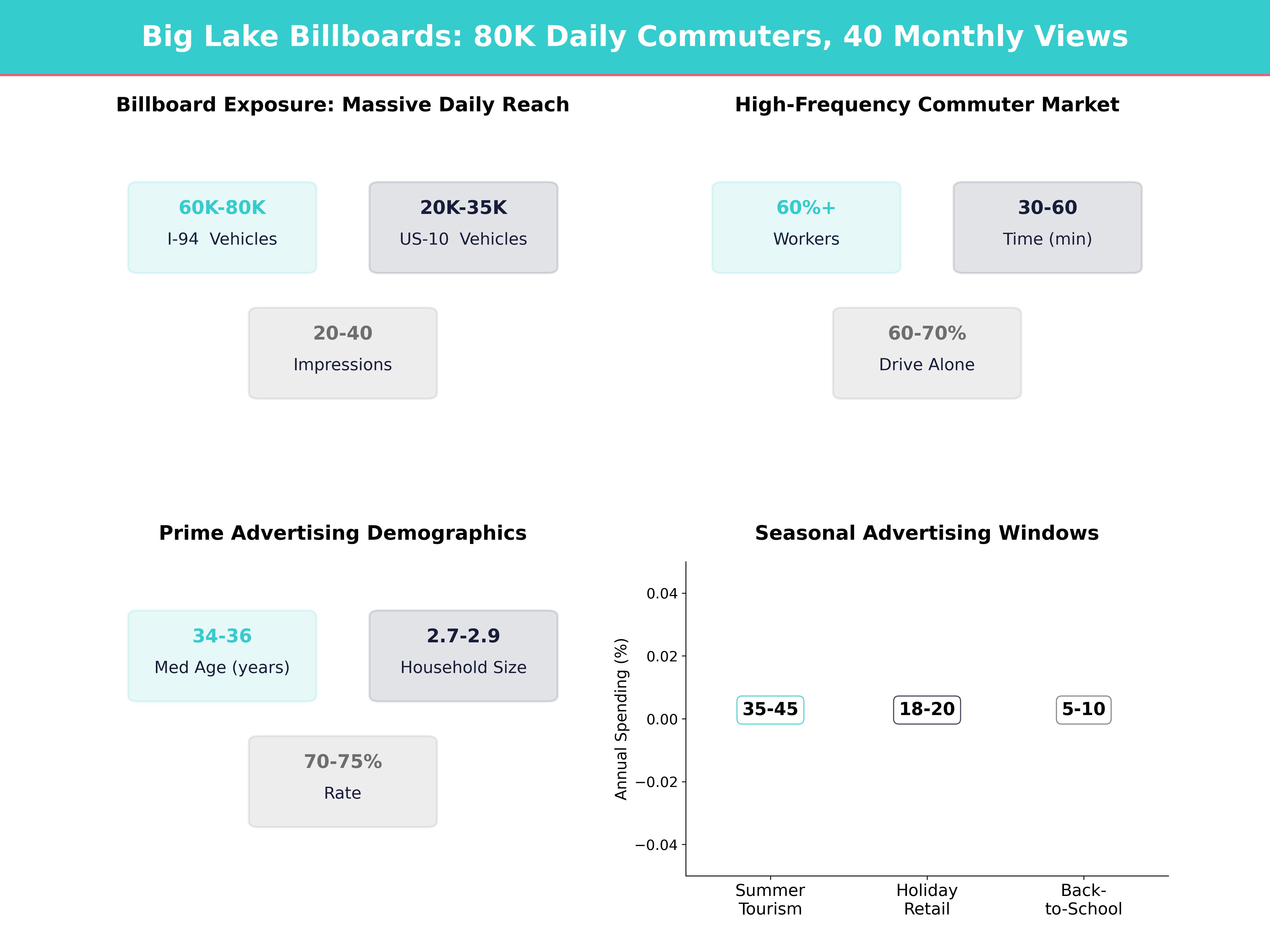
- The median age in the Big Lake area is in the mid‑30s (roughly 34–36 years), a full 3–4 years younger than the statewide median, indicating a strong base of young families and working professionals.
- Household sizes in the Big Lake area average around 2.7–2.9 persons per household, higher than the U.S. average of about 2.6, reinforcing the importance of family‑focused messaging.
- Owner‑occupied housing typically accounts for 70–75% of local housing units, signaling a stable base of long‑term residents and homeowners.
Big Lake’s position along U.S. Highway 10 and its Northstar commuter rail station, which connects to downtown Minneapolis, make the Big Lake area a classic “bedroom community” with significant daily travel patterns:
- The City of Big Lake notes more than 2,000–2,200 housing units within the city, with multiple new subdivisions and multifamily projects approved or under construction in recent years.
- Sherburne County building permit data show that in peak years, the county has issued 300–500+ new residential building permits annually, with Big Lake and nearby communities consistently among the most active.
- Northstar’s Big Lake station provides park‑and‑ride access to the Twin Cities; Metro Transit has reported weekday ridership on the Northstar line in the low thousands, meaning hundreds of daily commuters originate from or pass through the Big Lake area. Learn more from Metro Transit’s Northstar page.
- Commuting data for the broader corridor show that well over 60% of workers travel outside their home city for work, with many logging 30–60 minute one‑way commutes toward the northwest Twin Cities metro or St. Cloud.
For billboard advertisers, this blend of stable local households and steady commuter volume creates an opportunity to stay top-of-mind for everything from groceries, healthcare, and home services to recreation, automotive, and financial services. Well-placed Big Lake billboards that target these daily trips can reinforce your brand multiple times per week for the same driver.
Where Our Boards Are and Why They Matter
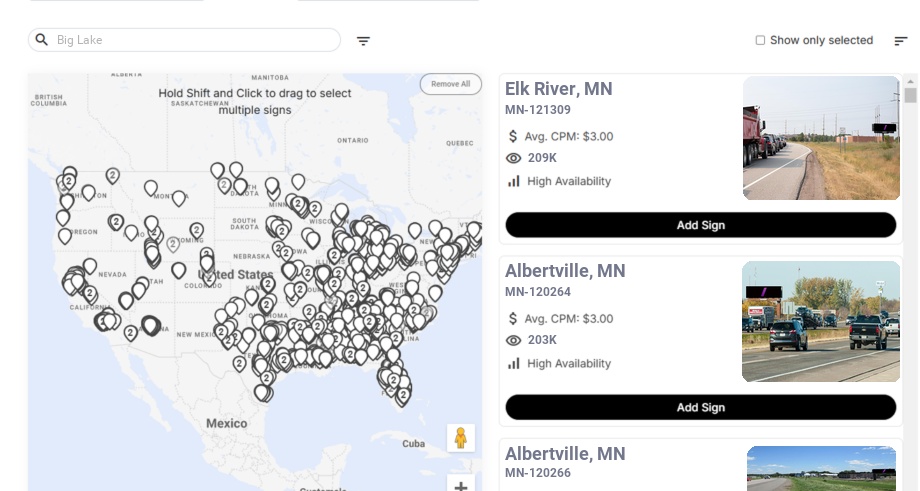
While there are currently no digital billboards inside the Big Lake city limits, our four digital billboards serving the Big Lake area are located in:
- Albertville, MN – approximately 8.1 miles from Big Lake
- Elk River, MN – approximately 9.8 miles from Big Lake
These are not random nearby towns; they are core destinations and pass‑through points for Big Lake area residents and ideal locations for billboards near Big Lake:
- Albertville is home to the Albertville Premium Outlets 100 stores and a trade area that stretches 30–60 miles. Outlet centers of this size can attract 5,000–20,000 visitors on busy weekends and generate tens of millions of dollars in annual retail sales. Local travelers from Big Lake, Monticello, St. Cloud, and the northwest metro routinely use I‑94 and County Road 19 to access this shopping hub. Learn more about the community through the City of Albertville
- Elk River is the Sherburne County seat and regional hub, with government services, big‑box retailers, auto dealerships, and healthcare, covered regularly by outlets such as the Elk River Star News City of Elk River. Elk River’s population is over 25,000 residents, and daytime population swells higher as workers and visitors come in for county, retail, and medical services.
By advertising near Albertville and Elk River, you’re reaching:
- Big Lake residents driving to work, shopping, or school activities (local K–12 enrollment in the broader area runs into the thousands of students, generating heavy parent traffic during school terms).
- Residents of neighboring communities such as Becker, Monticello, Otsego, and Zimmerman 60,000–80,000 people within a short drive.
- Through‑travelers on I‑94 and U.S. 10 who can be converted into visitors, customers, or repeat users of services based near Big Lake, especially when they repeatedly see Big Lake billboards on their regular route.
Traffic Patterns: How People Move Near Big Lake
To design an effective campaign, it helps to understand how vehicles flow through the area. According to the Minnesota Department of Transportation (MnDOT) traffic volume maps and recent local planning studies:
- Interstate 94 near Albertville often carries 60,000–80,000 vehicles per day, depending on segment and direction. During peak summer weekends and holidays, volumes can push toward the high end of that range as Twin Cities residents travel to and from lake country and St. Cloud.
- U.S. Highway 10 through the Big Lake–Elk River corridor carries 20,000–35,000 vehicles per day, capturing a large share of commuter traffic between the St. Cloud area and Minneapolis suburbs. Certain peak segments see morning and evening directional surges where traffic can be 30–40% higher in one direction.
- Major county and local roads feeding into Big Lake from I‑94 and Highway 10—such as County State Aid Highways serving Monticello, Becker, and Otsego—add several thousand additional daily trips each, providing multiple touchpoints for repeated billboard exposure across a typical week.
- MnDOT crash and safety studies show that average travel speeds on these corridors often range from 55–70 mph, meaning drivers have only a few seconds to process billboard messages at each pass.
From an advertising strategy standpoint, that means:
-
Boards near Albertville are ideal for:
- Reaching high‑income outlet shoppers and weekend travelers; outlet shoppers nationally tend to spend 20–30% more per trip than typical mall shoppers and often travel 20+ miles for deals.
- Branding for regional businesses that draw customers from a wide radius (furniture, auto, healthcare, tourism, and education), especially those with service areas spanning multiple counties.
-
Boards near Elk River are ideal for:
- Targeting Sherburne County residents, county employees, and people using regional services based around the Sherburne County Government Center.
- Capturing U.S. 10 commuters who live in the Big Lake area or pass through it daily, many of whom make the same trip 5 days per week, resulting in 20–40 billboard impressions per month per commuter.
Using Blip’s tools, we can schedule impressions on specific boards and time slots to sync with these travel flows—morning and evening commutes, weekend shopping spikes, and seasonal travel surges. This makes it easy to fine-tune billboard advertising near Big Lake so it shows up exactly when your audience is on the road.
Seasonal and Lifestyle Patterns in the Big Lake Area
Big Lake is literally named for the water that defines its lifestyle. The city features Big Lake and Lake Mitchell, public beaches, and parks that drive strong seasonal traffic. According to the City of Big Lake Parks Department
- Over a dozen parks and open spaces.
- A lakeside beach that can attract hundreds of visitors on peak summer days.
- Miles of paved trails and connections to regional trail networks that see consistent daily use in spring, summer, and fall.
Regional tourism statistics from state and local tourism agencies show that:
- Central Minnesota can see millions of visitor‑days per year, with lake and outdoor recreation trips peaking between Memorial Day and Labor Day.
- Summer tourism and recreation spending often accounts for 35–45% of annual visitor spending in lake‑focused communities.
This translates to distinct advertising seasons:
-
Summer (May–September)
- Lake use, boating, and camping peak during this period; local lakes, rivers, and nearby campgrounds can see double or triple their off‑season visitation.
- Big Lake area parks and events (such as “Music in the Park” and summer festivities promoted by the city or local organizations) bring in families and visitors multiple evenings per week, often drawing hundreds of attendees per event.
- Ideal for: tourism campaigns, restaurants, ice cream and beverage brands, marinas, power sports dealers, outdoor equipment, home improvement, and local attractions.
- Advertisers can capitalize on the fact that household discretionary spending on recreation typically increases 10–20% in summer months.
-
Back‑to‑School (August–September)
- Local schools in the Big Lake area and neighboring districts restart, increasing traffic on key routes and parent commuting patterns. District enrollment in nearby communities often numbers in the 2,000–4,000+ students, generating daily morning and afternoon traffic surges.
- Ideal for: youth activities, tutoring, healthcare checkups, retail, fitness, and family services.
- Retail data show that back‑to‑school spending is typically the second‑largest retail season of the year, accounting for 5–10% of annual sales in categories like apparel, electronics, and school supplies.
-
Fall & Holiday (October–December)
- Retail spending spikes in November–December. Nationwide benchmarks show holiday retail sales commonly account for 18–20% of annual retail revenue, with some specialty retailers seeing 25–30% of yearly sales in these months.
- Albertville Premium Outlets becomes an especially strong draw for holiday shoppers, with parking lots regularly reaching near‑capacity on key weekends and special sale days.
- Ideal for: retailers, e‑commerce pick‑up points, gift shops, events, churches, nonprofits fundraising, and financial institutions.
- Billboards that promote limited‑time offers or specific holiday events can tap into the 40–50% increase in foot traffic many centers see on peak holiday weekends.
-
Winter & Early Spring (January–April)
- Residents focus on essentials: health, finances, home maintenance, and indoor recreation. Many households use tax refunds and year‑start budgeting to plan major purchases and services.
- Healthcare utilization often rises in Q1 as people schedule annual physicals and dental visits, and fitness participation typically spikes in January before settling into steady routines by March.
- Ideal for: medical and dental practices, financial planners, tax services, gyms and studios, trades (HVAC, plumbing, electrical), and education programs.
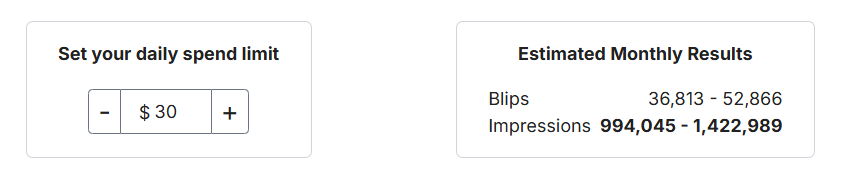
By leveraging daypart and date‑based scheduling through Blip, we can scale your campaign up during these critical seasonal windows and throttle back during quieter periods—protecting your budget while maximizing visibility when it matters most.
Who You’re Reaching: Demographic & Psychographic Insights
The Big Lake area and surrounding corridor share several key traits that influence what messages work best:
Creative Strategy: Designing Artwork for Big Lake Area Drivers
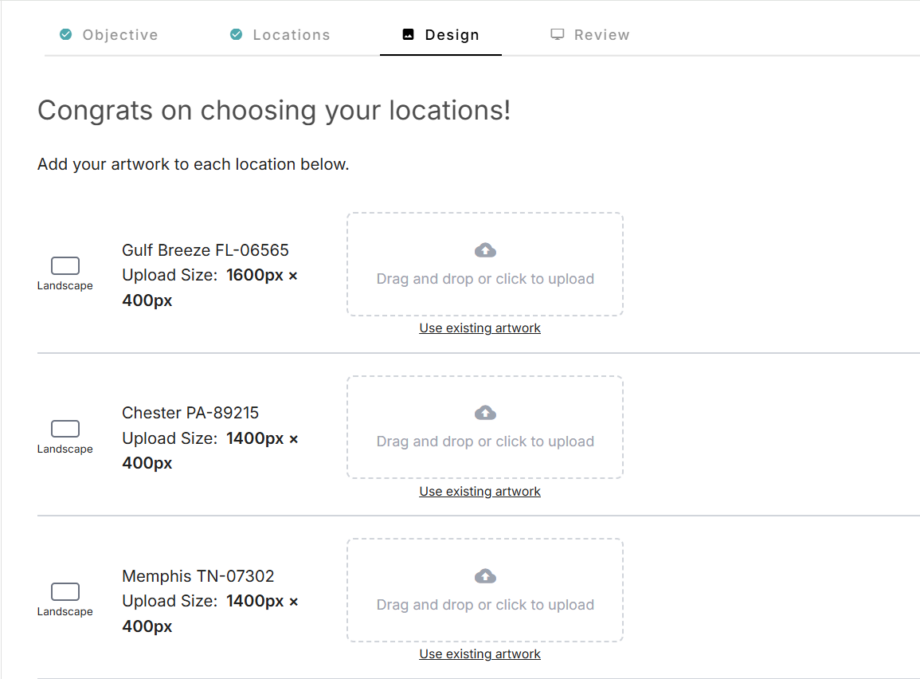
Digital billboards serving the Big Lake area compete with high‑speed traffic and multiple other visual elements. Artwork should be tuned to the ways people actually see and process your ad while driving.
Here are data‑backed creative guidelines:
-
Use 7 Words or Fewer
- Drivers typically have 6–8 seconds to absorb a billboard. Research in out‑of‑home advertising shows recall can drop by up to 30–40% when copy exceeds 7–10 words.
- Focus on a single idea: one offer, one action, one benefit.
-
Prioritize Large, High‑Contrast Text
- Use sans‑serif fonts, bold weights, and large type size (ideally filling at least one‑third of the board’s height for the main message).
- High‑contrast color pairings (e.g., dark text on light background, or vice versa) can improve readability at highway speeds by 20–30% compared to low‑contrast schemes.
-
Anchor to a Clear Call to Action
- “Exit in Albertville,” “10 Minutes from Big Lake,” “Book Online Today,” or “Text BIGLAKE to 555‑1234” are simple and measurable.
- If you’re based in or near the Big Lake area, explicitly say so: “Just 5 miles from Big Lake,” “Your Local Big Lake Area Dentist,” etc. Local references can increase perceived relevance and response rates by 10–20%.
-
Feature Local Visuals
- Incorporate subtle nods to the Big Lake area: lakes, boating, trees, snow scenes, or recognizable local imagery like the Big Lake beach or community events highlighted by the City of Big Lake.
- This helps ads feel relevant and local, especially when targeting commuters who pass between Albertville, Elk River, and the Big Lake area daily.
-
Rotate Multiple Creatives
-
With Blip, you aren’t locked into a single static design. Use:
- One branding creative (logo/tagline).
- One promotional or offer‑based creative.
- One seasonal or event‑specific creative.
- Rotating creatives keeps repeat viewers engaged and allows A/B testing to see which message performs best with your target audience. Marketers often see 10–30% improvements in response when they test and optimize creative rather than running a single design for months.
Timing Your Blips: Dayparting & Budget Strategy
Because the Big Lake area markets involve both local residents and through‑traffic, timing your ads can significantly affect ROI.
We can use Blip’s scheduling tools to:
-
Target Commuter Peaks
- Weekday 6–9 a.m. and 3–7 p.m. windows on U.S. 10 and I‑94 are ideal. Regional traffic studies indicate that 40–50% of daily vehicle volume can pass through during these peak blocks.
-
Ideal for:
- Coffee shops, breakfast restaurants, daycare, quick‑service restaurants on the way home, and service providers that take appointments.
- Consider call‑to‑actions like “Call on Your Lunch Break” or “Order Pickup for Tonight,” which align with how commuters make decisions during the day.
-
Focus on Weekend Shoppers
- Weekends (especially Friday evening–Sunday afternoon) are prime for Albertville outlet shoppers and errand‑running families from the Big Lake area. Retail corridors can see 20–40% higher volumes on Saturdays compared with mid‑week days.
- Retailers, entertainment venues, churches, and attractions can concentrate budgets on these windows to influence real‑time decisions.
-
Sync with Events & Seasonality
- If the City of Big Lake or Sherburne County is promoting festivals, parades, sports tournaments, or community events (often announced via the City of Big Lake website or local news like the Star News 2–4 weeks leading up to those dates.
- Blip’s flexibility allows you to start or stop campaigns instantly or adjust budgets daily without long‑term contracts, making it easy to align with seasonal spikes such as outlet holiday sales, fishing openers, or school events.
-
Use Frequency to Own a Moment
-
Instead of spreading your budget thin across all hours, you might:
- Concentrate your spend for maximum share of voice during your highest‑value time block.
- For example, a Big Lake area pizza restaurant could dominate 3–8 p.m. Thursday–Sunday, when dinner decisions are being made. Restaurants often see 50–70% of weekly sales concentrated in these evening and weekend windows.
High‑Potential Verticals in the Big Lake Area
Certain industries are particularly well‑positioned to benefit from digital billboards serving the Big Lake area:
-
Local Retail & Restaurants
- Residents frequently travel to Elk River and Albertville but still value convenient, close‑to‑home options in the Big Lake area. Surveys in similar suburban communities show that 60–75% of residents prefer to support local businesses when reminded of nearby options.
- Use billboards to remind them, “You don’t need to drive to Maple Grove” for great food, retail, or services.
- Promote specific offers: “Family Meal for 4 – 10 Minutes from Big Lake.”
- Pair billboard campaigns with features on local community pages or business directories such as the Big Lake Chamber of Commerce & Industry.
-
Auto Dealers & Repair Shops
- Elk River and Albertville host numerous dealerships and service centers, making the corridor a de facto auto hub for Sherburne and Wright counties.
- Auto ads on major corridors statistically perform well because vehicle ownership is nearly universal; in many rural/suburban counties, vehicle ownership rates exceed 95% of households, and more than 85–90% of workers** commute by car.
- Position your shop or dealership as the trusted choice for Big Lake area drivers, especially for routine services like oil changes, tires, and repairs that most vehicles need multiple times per year.
-
Home Services & Contractors
- The continued housing growth in the Big Lake area and Sherburne County feeds demand for HVAC, roofing, landscaping, electrical, plumbing, and remodeling. With hundreds of new housing units approved or built in recent years, even capturing 5–10% of that market can represent substantial revenue for local contractors.
- Home improvement spending nationally often accounts for 2–3% of household income annually, with spikes during spring and early summer.
- Billboards can reach both new homeowners and long‑time residents, positioning your brand as the default choice when issues arise.
-
Healthcare & Professional Services
-
Clinics, dentists, eye doctors, chiropractors, physical therapists, attorneys, and financial advisors can leverage community‑focused messaging:
- “Caring for Big Lake Area Families Since 2005”
- “Local Advisors, Local Decisions”
- In a community of 16,000–18,000 in the immediate trade area, even modest goals—like adding 20–50 new patients or clients per month—can significantly impact annual revenue.
- Connect messaging with local health and wellness initiatives supported by entities like Sherburne County Health & Human Services.
-
Education, Activities, and Nonprofits
- Youth sports, dance studios, music lessons, private schools, and colleges draw from a broad radius that easily includes Big Lake, Elk River, and Albertville. Youth activity providers in similar markets often report that 30–50% of participants come from outside the host city.
- Local school districts such as Big Lake Schools, ISD 727
- Nonprofits can use time‑limited bursts around campaigns, drives, or events to spur action and attendance, often seeing 2–3x increases in response during concentrated awareness pushes.
-
Tourism & Recreation
- Resorts, campgrounds, powersports dealers, and event venues across central Minnesota can reach Twin Cities plus Big Lake–area travelers as they head north and west along I‑94 and U.S. 10.
- State tourism data show that overnight visitors typically spend $100–200+ per person per day on lodging, food, gas, and activities, while day‑trippers still spend $40–80 per person.
- Pair scenic visuals with clear routing messages, such as “Turn at Big Lake Exit” or “Just North of Elk River,” and consider cross‑promoting with regional tourism sites like Visit Greater St. Cloud or local community events calendars.
Leveraging Local Media & Community Touchpoints
To amplify your billboard campaign, integrate it with other local channels:
-
Track local stories and events via:
-
Align your creative with what residents are already seeing and hearing:
- If a new park opens, a sports season begins, or a major road project starts, reference it in your creative to stay relevant—construction projects can shift 10–30% of traffic onto detour routes, changing which boards perform best.
- For example: “Construction on 10? We’re 5 Minutes Off the Detour.”
- Share consistent imagery or taglines between your billboard creatives and posts on local Facebook groups, school newsletters, or community calendars.
You can also coordinate your billboard flights with:
- Social media campaigns targeting the same zip codes (for example, zip codes serving Big Lake, Elk River, Albertville, Monticello, Becker, and Otsego).
- Local sponsorships (youth sports, school events, festivals) promoted by organizations like the Big Lake Chamber of Commerce & Industry.
- Email and SMS marketing blasts timed with your highest‑impact billboard rotations.
When residents see your brand consistently across billboards, news, and digital channels, recall and trust can increase by 20–40%, based on multi‑channel marketing studies.
Making the Most of Blip in the Big Lake Area
With four digital billboards serving the Big Lake area from Albertville and Elk River, we have a flexible, data‑driven canvas to reach your ideal audience. To maximize your results, we recommend:
-
Define a Clear Geographic Focus
- Decide whether your primary customers live in the Big Lake area, commute through it, or visit from a broader region. We can then prioritize boards and schedules accordingly—such as favoring U.S. 10‑facing boards if 70%+ of your customers commute that way, or I‑94 boards if you draw more from regional shoppers and tourists. This helps you choose the right billboards near Big Lake for your goals.
-
Set Measurable Goals
-
For example:
- “Increase website visits from Sherburne County and surrounding zip codes by 20% this quarter.”
- “Drive 300 additional in‑store visits from outlet‑center shoppers over 60 days.”
- “Add 100 new patient inquiries during our back‑to‑school campaign.”
- Use trackable offers, unique URLs, QR codes (for slower traffic zones and surface streets), or dedicated phone numbers.
-
Start with 2–3 Strong Creatives
- Keep copy short (ideally 7 words or fewer), visuals bold, and calls to action direct.
- Rotate seasonal or event‑based variants while maintaining consistent branding elements (logo, colors, tagline). Consistency across creatives can improve brand recognition by up to 3x over time.
-
Test, Learn, and Optimize
- Run different creative messages on the boards serving Albertville vs. Elk River and compare response by location—many advertisers find that one message outperforms another by 15–25% once tested.
- Adjust your time‑of‑day targeting based on when you see the strongest engagement (calls, orders, website traffic). Over time, you may discover that a few key 2–4 hour windows deliver the majority of your returns.
- Revisit your strategy at least quarterly to align with seasonal shifts in traffic, tourism, and local events posted on city and county websites.
By understanding how people live, work, shop, and travel near Big Lake—and by using Blip’s flexible tools to align your budget and creative with those patterns—you can turn the digital billboards in nearby Albertville and Elk River into a powerful growth engine for your brand throughout the Big Lake area. Whether you’re testing billboard rental near Big Lake for the first time or scaling an existing campaign, this corridor offers a cost‑effective way to stay visible with your best local and regional customers.