Below, we outline how to design smart, data-informed campaigns that perform exceptionally well near Mendota Heights using Blip’s flexible digital billboard platform, whether you’re testing billboard advertising near Mendota Heights for the first time or scaling an established presence.
Understanding the Mendota Heights Area Market
Mendota Heights is a small but economically powerful community at the heart of the southeast metro:
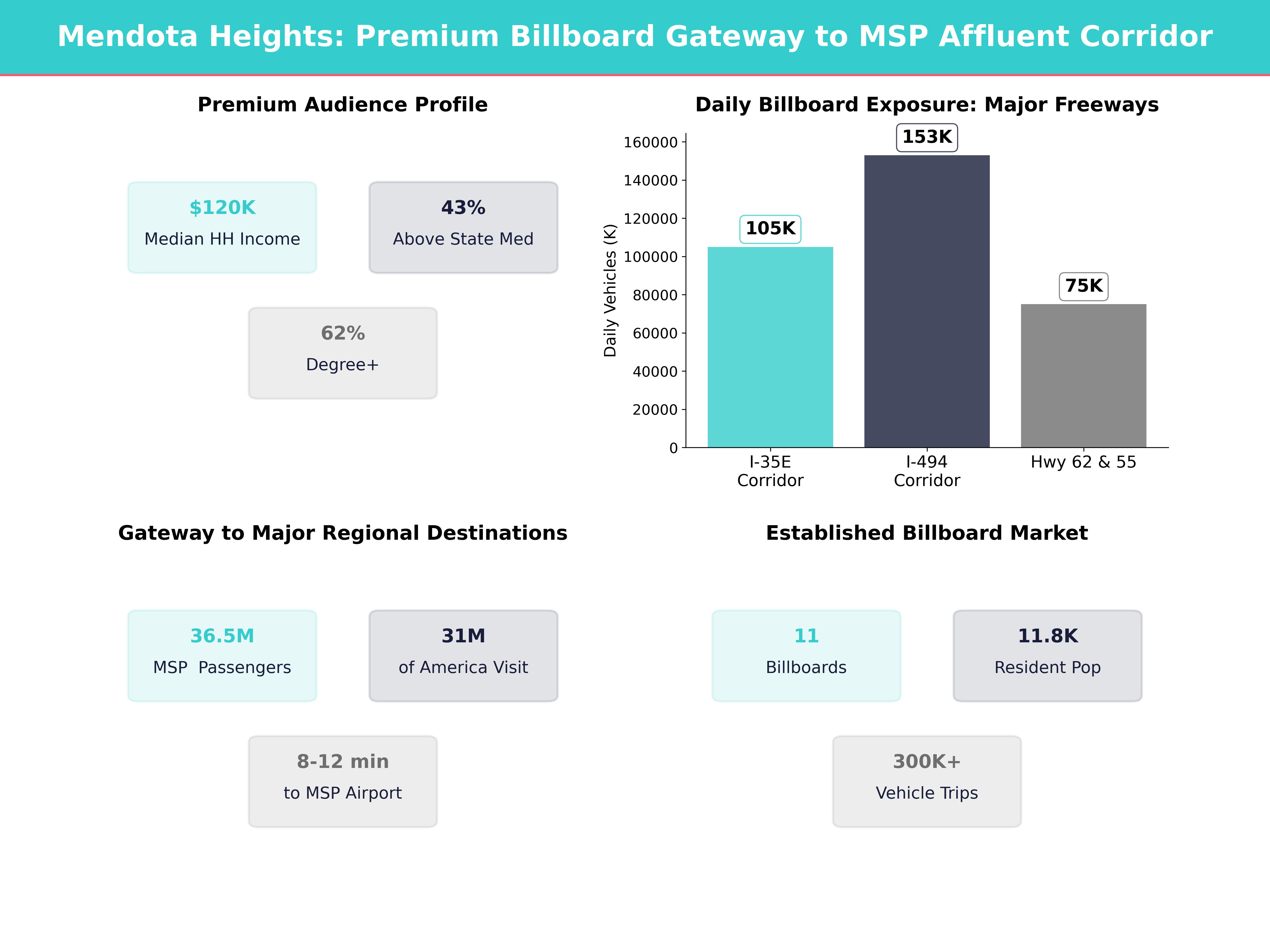
- Population: About 11,700–11,800 residents, based on recent estimates built off the 2020 Census count of 11,744.
- Median household income: Roughly $120,000–125,000, which is about 40–45% higher than Minnesota’s statewide median (around the mid-$80,000s).
- Education: Around 60–65% of adults hold a bachelor’s degree or higher, versus roughly 35–40% statewide, indicating a highly educated consumer base.
- Housing: Homeownership rates are typically around 80–85%, well above Minnesota’s statewide homeownership rate of roughly 73–75%, and the housing stock is dominated by single-family homes.
- Age profile: A strong presence of adults 35–64, with this group often making up 40–45% of residents—prime working-age, decision-making consumers.
The City of Mendota Heights
For additional local context, regional information is also provided by:
Key implications for advertisers:
- This is a high-spend market. Higher incomes and homeownership support campaigns for financial services, healthcare, luxury goods, home services, education, and professional services. Households at this income level typically spend 20–30% more than the U.S. average on categories like home improvement, travel, and personal services—making well-placed billboards near Mendota Heights especially valuable for these verticals.
- Residents commute widely, so the Mendota Heights area audience can be reached effectively along regional corridors near Eagan, Richfield, Inver Grove Heights, and Newport. In the broader Twin Cities region, typical one-way commute times hover around 23–25 minutes, meaning repeat, daily exposure to the same billboards.
- The population skews toward families, professionals, and established homeowners, making credibility, trust, and quality key themes in billboard creative. Family households often represent 60%+ of all households in similar first-ring suburbs.
Where Our Billboards Reach Drivers Near Mendota Heights
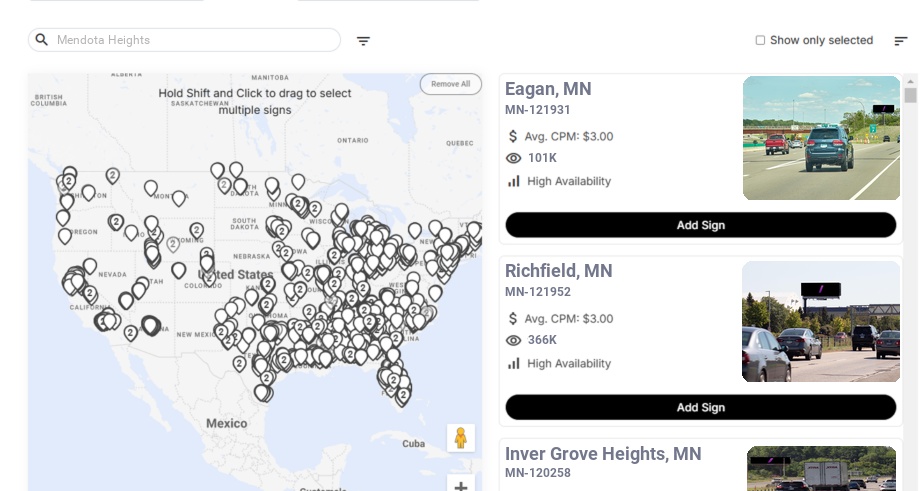
We have 11 digital billboards serving the Mendota Heights area, all within about 10 miles, strategically placed along high-traffic corridors in:
These nearby cities sit along some of the most important roadways for Mendota Heights–area traffic, making them ideal locations for billboard advertising near Mendota Heights:
- I-35E: Runs north–south just east of Mendota Heights, connecting the area to downtown Saint Paul and southern suburbs like Eagan. MnDOT traffic counts on I-35E near Mendota Heights and Saint Paul commonly reach 95,000–115,000 vehicles per day.
- I-494: A major east–west beltway just south of Mendota Heights, with volumes often around 140,000–165,000 vehicles per day near the airport and Eagan, according to Minnesota Department of Transportation (MnDOT) traffic data (accessible through MnDOT’s Traffic Data section).
- Hwy 62 (Crosstown) and Hwy 55: Important connectors between Mendota Heights, the airport, Bloomington, and Minneapolis, with many segments handling 60,000–90,000 vehicles per day.
Collectively, the freeways ringing Mendota Heights carry well over 300,000 vehicle trips per weekday, giving digital billboards in this zone the potential to generate millions of impressions every week when schedules are optimized. For advertisers exploring billboard rental near Mendota Heights, these corridors offer predictable, high-frequency exposure to both local and regional audiences.
Eagan, Richfield, Inver Grove Heights, and Newport placements allow you to:
- Reach Mendota Heights–area residents heading to and from work in downtown Saint Paul, downtown Minneapolis, Eagan corporate campuses, and the airport. In the Twin Cities, about 75–80% of workers drive alone or carpool, so road-based media is the dominant way to reach commuters.
- Capture travelers and workers using MSP Airport, which handled approximately 39.5 million passengers in 2019, dropped to about 14 million in 2020, and rebounded to more than 34–35 million passengers per year in recent years.
- Reach visitors and shoppers bound for Mall of America in Bloomington, which typically reports over 30–32 million visitors annually, and the Viking Lakes mixed-use development and training facility in Eagan, which regularly hosts Minnesota Vikings activities and regional events.
When we select boards near Mendota Heights, we can think of them in three functional clusters:
-
Airport / I-494 / Eagan Cluster – Ideal for:
- Targeting Mendota Heights residents commuting to Eagan employers (e.g., Blue Cross and Blue Shield of Minnesota or Thomson Reuters in Eagan, as well as other large office campuses employing thousands of workers).
- Reaching business travelers and tourists heading to and from MSP and Mall of America.
-
Saint Paul Access / Newport / Inver Grove Heights Cluster – Ideal for:
- Capturing commuters from Mendota Heights and Dakota County driving toward downtown Saint Paul and the East Metro, where tens of thousands of workers enter the core each weekday.
- Reaching industrial, logistics, and river corridor workers in areas where daytime worker populations can be 2–3 times the number of nearby residents.
-
Richfield / Crosstown Cluster – Ideal for:
- Connecting with Mendota Heights–area drivers heading west to Minneapolis, Edina, or southwestern suburbs via I-494 and Hwy 62.
- Aligning with retail, dining, and healthcare choices along the Crosstown corridor and Richfield’s major retail nodes, including areas adjacent to Southdale, Best Buy’s corporate campus, and other regional draws.
Audience Segments in the Mendota Heights Area
Because Mendota Heights is small but centrally located, it’s crucial to think in terms of audience segments rather than just geography. The major segments likely to see our boards serving the Mendota Heights area include:
1. Suburban Professionals & Commuters
- Many Mendota Heights–area residents work in downtown Saint Paul, downtown Minneapolis, Eagan, and Bloomington. Regional employment hubs like downtown Minneapolis and Saint Paul together account for well over 200,000 jobs, and the I-35E / I-494 corridors funnel those workers past our boards.
- In the Twin Cities metro, typical commute times average roughly 23–25 minutes, with a substantial share of commuters traveling 10–20 miles each way—precisely the distance between Mendota Heights and major job centers.
- These professionals value time-saving services, reliability, and reputation. Households in higher-income brackets are often 50% more likely than average to use professional services such as financial planners, private healthcare clinics, and home maintenance contracts.
Effective messages:
- “Same-day service in the Mendota Heights area”
- “Trusted by Mendota Heights homeowners since [year]”
- Clear offers for banking, legal services, home contracting, or healthcare.
2. Family & Youth-Oriented Households
Mendota Heights’ residential character and park system create strong family segments:
- Family households typically account for 60–65% of occupied housing units in comparable first-ring suburbs, with many households including children under 18.
- The city maintains a wide variety of parks and recreational programs; see the city’s Parks & Recreation information at the City of Mendota Heights over a dozen parks and natural areas plus extensive trail mileage, making local outdoor recreation a regular part of family life.
- The community is served by School District 197 (West St. Paul–Mendota Heights–Eagan Area Schools) and nearby private schools, generating pronounced school-oriented traffic peaks on weekdays.
- School-oriented traffic patterns (school days, afternoons, evenings) drive repeat impressions as parents and students travel the same routes multiple times per week. A typical school commute can add 4–10 extra vehicle trips per week per household.
Effective messages:
- Promotions for after-school programs, tutoring, youth sports, family dining, and healthcare.
- Emphasis on safety, local roots, and community, which consistently scores highly in regional household preference surveys.
3. Airport, Hospitality, and Visitor Traffic
Given the proximity to MSP Airport and the regional freeway network:
- MSP directly supports tens of thousands of jobs and serves 34–39 million passengers annually in recent years, plus substantial daily volumes of airport employees, rental car users, and ride-share traffic.
- Nearby hotels in Eagan, Bloomington, and along I-494 collectively provide thousands of hotel rooms, with occupancy spiking around major events, Vikings games, and convention activity.
- Tourism information from Explore Minnesota Visit Saint Paul and Meet Minneapolis highlight ongoing travel and events that drive hotel, dining, and attraction demand. Minnesota tourism has recently generated tens of millions of annual overnight stays and billions in visitor spending statewide.
Effective messages:
- Wayfinding or “next exit” ads for lodging, dining, and attractions near the airport or along I-494 and I-35E.
- “Only 10 minutes from the airport” or “5 minutes from Mendota Heights” style callouts, backed by real drive-time estimates; Mendota Heights to MSP is typically 8–12 minutes in normal traffic.
4. Local Workers & Industrial / Service Employees
To the east and south of Mendota Heights, Inver Grove Heights, Newport, and parts of Eagan host distribution, industrial, and service jobs:
- Industrial clusters along the Mississippi River, I-494, and I-52 corridors employ thousands of workers, many starting shifts between 5–8 a.m. and ending mid-afternoon or late evening.
- Many of these workers commute from across Dakota, Ramsey, and Washington counties, leading to substantial early-morning and midafternoon traffic that is distinct from traditional office-peaks.
- This is an ideal audience for quick-service restaurants, auto repair, trade schools, and staffing firms, as industrial and service workers are often more receptive to nearby, convenience-based offers.
Timing Your Campaign in the Mendota Heights Area
Blip’s flexibility lets us buy by the “blip” (a single display) and schedule dayparts precisely. For Mendota Heights–area campaigns, timing can dramatically influence who sees you, especially when you’re structuring billboard advertising near Mendota Heights to match specific audience behaviors.
By Time of Day
Regional traffic data from MnDOT shows that freeway volumes around Mendota Heights often vary by 30–50% between the lowest and highest hours of the day, emphasizing the value of daypart targeting.
-
Morning Commute (6–9 a.m.)
- Peak for professional commuters heading from the Mendota Heights area toward Saint Paul, Minneapolis, Eagan, and Bloomington.
- On many Twin Cities freeways, 7–8 a.m. is among the highest-volume hours of the day.
- Best for coffee shops, breakfast QSR, traffic-driven apps, local news, and urgent home services.
-
Midday (10 a.m.–3 p.m.)
- Volumes dip slightly but remain substantial—often 60–75% of peak commuter volumes.
- Strong for errands, retirees, remote workers in transit, and service visits.
- Great window for healthcare, banking, home services, retail, and B2B messages targeting business parks.
-
Afternoon School / Early Evening (3–7 p.m.)
- Families and after-school traffic, plus workers returning home; in many corridors, 4–6 p.m. rivals or exceeds morning peaks.
- Ideal for restaurants, family activities, fitness, education, and sports programs.
-
Late Evening (7–11 p.m.)
- Lighter traffic (often 40–60% of peak volumes) but efficient CPMs; good for branding and entertainment messages where frequency is more important than reach.
With Blip, we can adjust bids by hour so you spend more during your high-value windows (e.g., 6–9 a.m. and 3–7 p.m.) and scale back during lower-priority times while still maintaining some presence.
By Day of Week
- Monday–Thursday: Strong habitual commuting; best for consistent, everyday offerings (banking, healthcare, grocery, home services). Monday and Tuesday often show the most stable and predictable patterns.
-
Friday:
- Higher restaurant, entertainment, and retail interest, with evening traffic sometimes 10–15% higher near major shopping and dining nodes.
- Great for weekend event promotions in Saint Paul, Minneapolis, or at local venues.
-
Saturday–Sunday:
- More discretionary trips: shopping, recreation, family activities. Weekend traffic around Mall of America and regional retail areas can rival weekday peaks.
- Consider heavier weekend exposure for museums, attractions, churches, fitness centers, and retail.
Use Blip’s scheduling to ramp up bids Thursday–Sunday if your business depends on weekend activity.
By Season
Local media such as the Star Tribune Pioneer Press regularly cover seasonal patterns—school calendars, sports seasons, festivals, and winter weather—that affect traffic and consumer behavior.
Key Mendota Heights–area seasonal patterns:
-
Winter (Dec–Feb):
- Longer dark hours improve billboard visibility: in December, the Twin Cities often see less than 9 hours of daylight, meaning a majority of commuting occurs in low light where digital billboards stand out.
- Snow and cold increase demand for auto, home services, healthcare, and indoor activities; local winter events and youth sports (hockey, basketball) also boost evening traffic to specific venues.
-
Spring (Mar–May):
- Strong for home improvement, landscaping, real estate, tax services, and youth sports. In many northern metros, spending on home and garden categories jumps 20–30% from winter to spring.
- Real estate listings typically ramp up, with many Twin Cities markets seeing 25–40% more new listings between February and May.
-
Summer (Jun–Aug):
- More road trips, outdoor recreation, and construction season. State and county construction projects can redirect thousands of vehicles per day to alternate routes—often right past billboards.
- Ideal for events, attractions, summer programs, and tourism-serving businesses; both Visit Saint Paul and Meet Minneapolis highlight a dense summer calendar of festivals, concerts, and sports.
-
Fall (Sep–Nov):
- Back-to-school, youth sports, and preparation for winter; household spending on education, clothing, and services spikes in August–September.
- Great window for education, insurance, medical, and big-ticket home projects as households make year-end decisions.
We can time creative rotations in Blip so your messaging changes with these seasonal shifts—without printing new vinyl each time, and while keeping your Mendota Heights billboards fresh and relevant.
Creative Best Practices for the Mendota Heights Area
To stand out on digital billboards serving the Mendota Heights area, we recommend:
1. Lead With Location Relevance
Because drivers may be coming from or going to many different suburbs and downtowns, it’s critical to anchor your ad:
- “Minutes from the Mendota Heights area on [Route/Exit]”
- “Serving Mendota Heights, Eagan & Inver Grove Heights”
- “Near MSP & Mall of America”
This helps viewers quickly understand whether your offering is on their path. Location cues can improve recall by 10–20% compared with generic messaging, based on typical out-of-home (OOH) industry studies. They also immediately signal that your billboards near Mendota Heights are relevant to local drivers rather than just passing through traffic.
2. Match the Professional, High-Income Profile
Mendota Heights–area consumers respond well to:
- Clean, minimalist layouts.
- Professional photography vs. clip-art.
- Strong, credible brand markers (years in business, locally owned, testimonials, accreditations).
For example:
- “Trusted by over 5,000 Twin Cities families”
- “Board-certified specialists serving the Mendota Heights area”
- “Locally owned for 30+ years”
Including concrete proof points (years in business, number of clients) can increase perceived credibility by 20–30% in controlled tests compared with generic claims.
3. Keep Copy Short and Data-Driven
We generally recommend:
- 6–8 words max, plus a logo and simple call to action; at freeway speeds, drivers have only 5–8 seconds to process your message.
- One bold focal point: an offer (“$49 exam”), a promise (“Same-day install”), or direction (“Next exit, left on [Street]”).
Metrics you can safely show:
- “Rated 4.8★ on 1,200+ reviews”
- “Serving the Mendota Heights area for 25 years”
- “Over 10,000 patients cared for annually”
- “Save up to 30% on energy bills”
Data-based messages typically produce higher engagement and trust than vague slogans, especially with educated, professional audiences.
4. Use Color and Contrast for All-Weather Visibility
Minnesota’s changing light and weather conditions demand strong contrast:
- Light text on dark background or vice versa.
- Avoid thin fonts and low-contrast color combinations (like red on dark blue).
- Make sure critical text is at least 18–24 inches tall in real-world scale (your designer or printer can translate this into pixels for the actual board specs). At 60–65 mph, larger text significantly improves legibility.
- Plan for snow, rain, and dusk conditions that can reduce visibility by 30–50%; high contrast helps maintain readability.
5. Rotate Multiple Creatives Strategically
With Blip, you can upload multiple creatives per campaign:
-
Message sequencing:
- Creative 1: “Back pain?”
- Creative 2 (same board, later in the loop): “Specialists near the Mendota Heights area.”
- Creative 3: “Call [phone] or visit [short URL].”
-
A/B testing:
- Version A: price-focused (“$99 Intro Special”).
- Version B: credibility-focused (“Voted #1 in local survey”).
- Watch which aligns with spikes in web traffic, phone calls, or store visits; in many campaigns, one variant outperforms another by 20–40%.
Rotating creatives every 4–8 weeks can reduce “ad fatigue” for commuters who see the same board 10–20 times per week.
Sample Strategies for Common Business Types
Below are concrete examples of how to use our Mendota Heights–area inventory effectively.
Local Restaurants & Cafés
Target audience: Commuters, residents, and airport/office workers.
Local context:
- The Twin Cities region has a strong dining-out culture, with households typically spending 10–15% more on food away from home than the national average.
- Corridors around I-494 and I-35E near Eagan and Richfield carry hundreds of thousands of daily vehicle trips, many of them to office parks and retail nodes.
Strategy:
- Focus boards in Eagan and Richfield along I-494 and I-35E.
- Heavy 7–9 a.m. for breakfast, 11 a.m.–1 p.m. for lunch, and 4–7 p.m. for dinner.
-
Messages like:
- “Breakfast 5 min from the Mendota Heights area – [Exit Info]”
- “Kids eat free Tues – [Restaurant Name]”
- “Show this ad for 10% off – Today only”
Use weekend-heavy schedules to catch shoppers heading to big-box retail and Mall of America. Retail hubs of this scale can attract tens of thousands of visitors per day on peak weekends, and Mendota Heights billboards on nearby corridors help keep your brand top-of-mind as those visits start.
Healthcare Providers & Clinics
Target audience: Families, professionals, seniors.
Local context:
- Higher-income, well-educated suburbs tend to have above-average utilization of preventive and specialty healthcare services.
- The Twin Cities healthcare market is dense, with major systems like Allina, HealthPartners, and M Health Fairview operating multiple clinics and hospitals across the region.
Strategy:
- Use boards that serve the Mendota Heights area along I-35E and I-494 in Eagan and Inver Grove Heights.
- Weekday, all-day coverage with slightly higher bids during 7–9 a.m. and 3–7 p.m., coinciding with work and school commutes.
-
Messaging:
- “Urgent care near the Mendota Heights area – Open 7 days”
- “Same-day appointments | [Clinic Name]”
- “New patients seen within 24 hours”
Drive to a short URL or easy-to-remember name; reinforce reputation and convenience with stats like “4.9★ rating” or “Over 20,000 visits last year.”
Home Services (HVAC, Roofing, Landscaping, Remodeling)
Target audience: Homeowners with higher discretionary income.
Local context:
- With homeownership rates often 80–85% in Mendota Heights and nearby suburbs, homeowner-focused services have a large base.
- Minnesota’s climate swings—from subzero winters to hot, humid summers—drive strong seasonal demand for HVAC, roofing, insulation, and landscaping. Extreme weather events can spike inbound calls by 50%+ over typical weeks.
Strategy:
- Year-round presence, with spikes in spring (landscaping, roofing) and fall/winter (heating, insulation).
-
Emphasize:
- “Serving Mendota Heights & surrounding areas”
- “Free estimates | Call [short number]”
- Seasonal triggers: “Prepare for winter now – Furnace tune-ups”
- When severe weather is forecast (hail, heat waves, cold snaps), escalate bids for a 3–10 day window to capture urgent, high-intent demand.
Focus placements near I-35E and I-494 corridors where Mendota Heights–area residents travel daily; a typical commuter can see a well-placed board twice daily, 5 days per week, leading to 40+ impressions per month from the same driver.
Financial, Legal, and Professional Services
Target audience: High-income professionals and small business owners.
Local context:
- With median household incomes above $120,000, Mendota Heights households are prime prospects for wealth management, tax planning, and legal services.
- In many affluent suburbs, 30–40% of households have investable assets over $250,000, and small business ownership is common among residents.
Strategy:
-
Professional, brand-forward creative with strong hooks:
- “Wealth management for Mendota Heights–area families”
- “Business law for Twin Cities entrepreneurs”
- “Tax planning for incomes over $200,000”
- Run heavier exposure during tax season (Jan–Apr) and year-end planning (Oct–Dec), when financial decision-making peaks.
- Consider boards in Richfield and Eagan that catch both east–west (I-494) and north–south (I-35E) commuters, expanding your reach to professionals heading to corporate campuses and downtown offices. This approach makes billboard rental near Mendota Heights an efficient part of a broader Twin Cities marketing strategy.
Events, Attractions, and Tourism
Target audience: Residents plus regional visitors.
Local context:
- The Twin Cities host hundreds of major events annually, from professional sports and concerts to festivals and conferences.
- Regional attractions like Mall of America, Viking Lakes, and downtown Saint Paul/Minneapolis venues draw visitors from across the Upper Midwest.
Strategy:
- Time-limited campaigns before events at venues in Saint Paul, Minneapolis, Eagan, or Bloomington.
- Use boards near I-494 (Eagan/Richfield) and I-35E (Inver Grove Heights/Newport) for widest coverage.
-
Example messaging:
- “This weekend only – [Event Name] – 10 min from the Mendota Heights area”
- “Exit [number], follow signs to [Venue]”
- “Free parking – [Date] – [Short URL]”
Work backward from your event date; ramp impressions 2–3 weeks out for awareness, then saturate the final 7–10 days, when ticket purchases and plan-making peak. For single-date events, a 5–7 day heavy push can deliver strong impact with efficient spend and ensure your billboards near Mendota Heights reach both locals and visiting attendees.
Using Local Data and Media to Fine-Tune Your Campaign
To refine your Mendota Heights–area billboard strategy, we recommend keeping an eye on:
-
City of Mendota Heights
- Road construction and detours that might shift traffic.
- Dakota County information for regional planning, business climate, and transportation projects.
- City of Eagan for business news, events, and development near I-494 and key retail nodes.
- City of Richfield for updates on Crosstown and I-494-area projects and redevelopment.
-
Local news outlets for:
-
Major employer announcements, office expansions, and school calendar changes that affect commuting patterns:
Aligning your Blip campaign start and end times around road projects, school openings, and big local events can significantly increase relevance and performance. For example, detours can reroute thousands of vehicles daily past alternative corridors where we can temporarily concentrate your impressions, maximizing the impact of billboard advertising near Mendota Heights during those windows.
Optimizing and Growing With Blip
Finally, once your initial campaign is live, we can treat Mendota Heights–area advertising as an ongoing optimization process:
- Start with core commuter boards in Eagan and Inver Grove Heights to ensure strong coverage for Mendota Heights–area drivers. These corridors alone can expose your message to tens of thousands of unique drivers each week and form the foundation of any effective Mendota Heights billboards strategy.
- Layer on additional boards in Richfield and Newport once you see positive response, extending your reach across more commute paths and capturing cross-metro trips between Minneapolis, Saint Paul, and the southern suburbs.
-
Adjust bids and dayparts monthly based on:
- Web analytics (direct and branded search volume, which often rises 10–30% after sustained OOH campaigns).
- Call volume and form fills.
- Store traffic and promotion redemptions.
-
Refresh creatives regularly (every 4–8 weeks) to:
- Highlight new promotions.
- Reflect seasonality (winter services, back-to-school, tax season, etc.).
- Prevent creative fatigue for frequent commuters who may see the same board dozens of times per month.
By combining local data, flexible scheduling, and targeted messaging, we can use digital billboards near Mendota Heights to build awareness, drive action, and keep your brand top-of-mind across the daily journeys of one of the Twin Cities’ most valuable suburban audiences, all while making billboard rental near Mendota Heights simple, measurable, and scalable over time.