Understanding the Bloomington Area Market
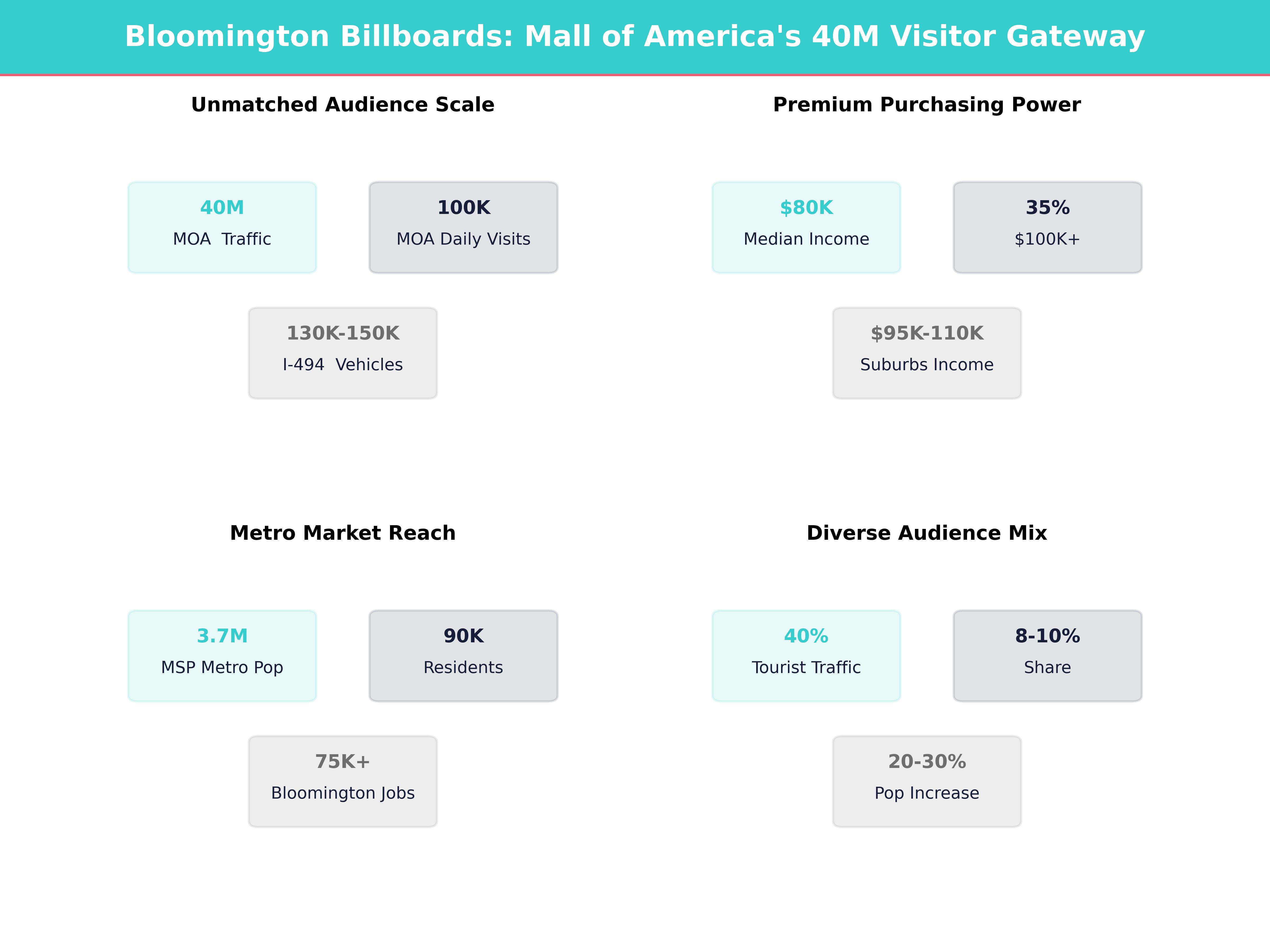
Bloomington is a mature, affluent, and travel‑heavy suburb with far more daily visitors than residents, which makes Bloomington billboards especially powerful for advertisers who want both local and regional reach.
For advertisers, this means a single campaign near the Bloomington area can simultaneously touch stable local households, high‑intent shoppers, and transient but high‑value travelers. Well‑placed billboard advertising near Bloomington can efficiently speak to all three groups in one unified media buy.
Where Our Billboards Are and What That Means Strategically
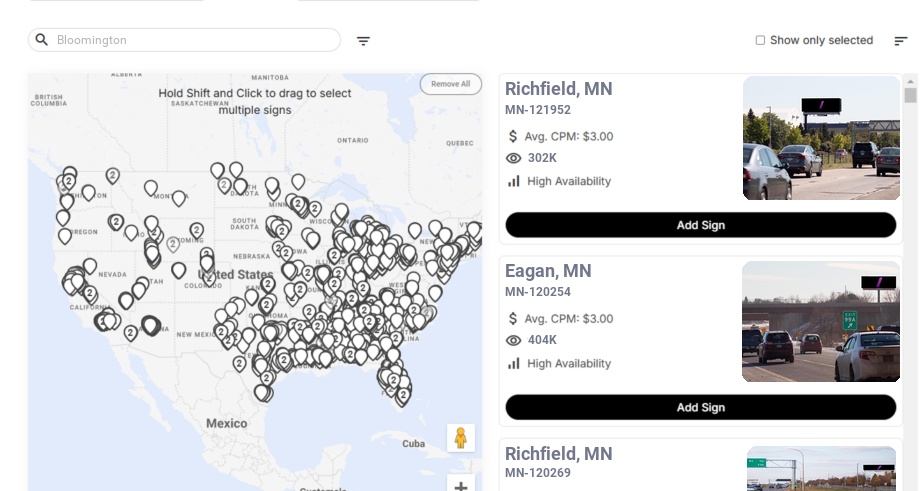
Blip’s 4 digital billboards serving the Bloomington area are located in:
These nearby cities sit on high‑traffic highways used constantly by Bloomington‑bound drivers, so they function in practice as billboards near Bloomington even though the structures sit just outside the city limits:
- I‑494 – The main east–west beltway south of Minneapolis, carrying heavy commuter and commercial traffic to and from the Bloomington area, MOA, and MSP. On segments between Highway 77 and I‑35W, MnDOT reports 130,000–150,000 vehicles per day.
- I‑35W – A major north–south connector into Minneapolis, intersecting I‑494 just west of Bloomington, with average daily traffic often in the 90,000–130,000 vehicles per day range near the interchange.
- Highway 77 (Cedar Avenue) – A principal route feeding directly into MOA and MSP from the south (Apple Valley, Lakeville) and north (Minneapolis, Richfield), typically seeing 80,000–110,000 vehicles per day near the river crossings.
- I‑35E and Highway 13 near Eagan – Serving commuters from Dakota County into employment and retail centers in and near the Bloomington area, with key stretches drawing 70,000–100,000 vehicles per day.
According to MnDOT, these corridors regularly see 80,000–150,000 vehicles per day on the busiest segments around MSP and I‑494. Even capturing a modest share of impressions—such as 1–3 seconds of dwell time per passing vehicle—can translate into hundreds of thousands of weekly ad views per board. That volume, combined with digital flexibility, allows you to:
- Capture daily commuters traveling between Bloomington‑area employers and the broader metro.
- Reach suburban families from Dakota, Scott, and Hennepin counties heading to MOA, IKEA, and other Bloomington‑area retailers.
- Intercept airport traffic—friends and family picking up passengers, business travelers, and rideshare drivers—on their way to hotels and meetings near the Bloomington area. MSP sees 60,000–100,000 passengers per day, and many of those trips generate multiple vehicle journeys (drop‑offs, pick‑ups, and hotel shuttles).
Collectively, these faces form a powerful, flexible billboard rental near Bloomington for businesses that want to reach people right before they enter the city’s key commercial corridors.
Key Audience Segments to Target
When planning creative and scheduling, it helps to think about distinct audience types in the Bloomington area.
-
Local Residents and Commuters
- Bloomington’s median age is around 40, very close to the state average, with strong representation of young professionals, families, and empty nesters.
- Roughly 65–70% of employed residents commute by car, and many travel to jobs along I‑494, I‑35W, or into Minneapolis/Saint Paul. Typical commute times in the south metro average around 23–26 minutes.
- Homeownership rates are around 60–65%, meaning solid demand for home services, remodeling, lawn care, roofing, HVAC, and financial products.
- Within a 10–15‑minute drive radius of Bloomington and Richfield, there are well over 200,000 residents and 80,000+ households, forming a large, repeat‑exposure audience for frequency‑based campaigns.
Strategy ideas:
- Use peak weekday rush hours (6–9 a.m., 3:30–6:30 p.m.) on Richfield and Eagan boards to reach Bloomington‑area commuters. During these windows, traffic speeds can drop below 30 mph, increasing ad readability and making Bloomington billboards especially noticeable.
- Promote recurring local needs: healthcare clinics, auto repair, childcare, insurance, and banking.
- Consider “always‑on” commuter messaging with modest bids and then increase bids by 20–30% during Monday mornings and Friday afternoons, when traffic is often heaviest.
-
Shoppers and Families Heading to Mall of America
- MOA sees an average of 100,000+ visitors per day on busy weekends and holidays, with some major event days drawing 150,000+.
- The mall includes over 500 stores, 50+ restaurants, and attractions spanning 7+ acres of indoor amusement space, including Nickelodeon Universe, an aquarium, and mini‑golf.
- According to Bloomington tourism data, more than 75% of Twin Cities residents visit MOA at least once per year, and many families make multiple trips during back‑to‑school and holiday seasons.
Strategy ideas:
- Time messages to weekends and holiday evenings, when family traffic into the Bloomington area spikes; MOA weekends often see 20–30% higher visitor counts than weekdays.
-
Promote:
- Attractions and experiences (escape rooms, trampoline parks, arcades).
- Restaurants and dessert spots, especially those a short drive from MOA.
- Retailers offering alternatives or complements to MOA shopping, such as outlet centers, furniture stores, or specialty shops nearby.
- Use urgency in copy—“Today Only,” “This Weekend,” “Ends Sunday”—to convert families already in a buying mindset.
-
Tourists and Business Travelers
- MSP is a Delta hub with robust business traffic and conventions; pre‑pandemic, over 40% of MSP passengers were business travelers, and corporate travel has been steadily recovering.
- The Bloomington area has more than 40 hotels and 9,000+ hotel rooms, many concentrated near MOA and the I‑494 corridor, making it one of the largest lodging clusters in Minnesota.
- Bloomington Convention & Visitors Bureau 80% during major events, summer weekends, and peak convention dates.
Strategy ideas:
- Use location‑focused copy like “5 minutes from Mall of America” or “Next exit toward MSP Airport” to orient non‑locals who may be unfamiliar with the area.
- Emphasize ease and convenience: shuttles, parking, extended hours, or multilingual support. For example, “Free MSP shuttle every 30 minutes” or “Free parking while you shop.”
- Consider weekday midday and evening schedules to capture hotel check‑ins (typically 3–8 p.m.) and business travel patterns.
- Coordinate with major conventions or events listed by the Bloomington Convention & Visitors Bureau
-
Regional Suburban Shoppers
- Households from Apple Valley, Burnsville, Lakeville, Eagan, and Shakopee frequently travel through the Bloomington area for shopping and entertainment. Many of these communities are within a 20–25‑minute drive of MOA via I‑35E, I‑35W, Highway 77, or Highway 13.
- These suburbs often have median household incomes above $90,000–$100,000, representing strong discretionary spending on dining, entertainment, and large‑ticket items like furniture, vehicles, and home improvement.
- The south‑metro retail trade area that funnels into MOA serves hundreds of thousands of residents and can generate billions of dollars in annual retail sales across categories.
Strategy ideas:
- Use Eagan‑side boards to speak directly to south‑metro suburban families heading toward MOA or Bloomington‑area big‑box stores.
- Highlight promotions, limited‑time sales, or “this weekend only” events to trigger planned shopping trips.
- Call out easy access, such as “Just off Cedar Ave” or “Exit 494 at [Street],” to reassure drivers making longer cross‑suburb trips.
Timing Your Campaign: Traffic and Daypart Insights
The Bloomington area’s traffic is highly patterned, and Blip’s flexible scheduling lets us align your spend with those peaks. When you’re planning billboard advertising near Bloomington, matching message timing to these patterns can significantly improve results.
Weekday Patterns
Weekend and Seasonal Peaks
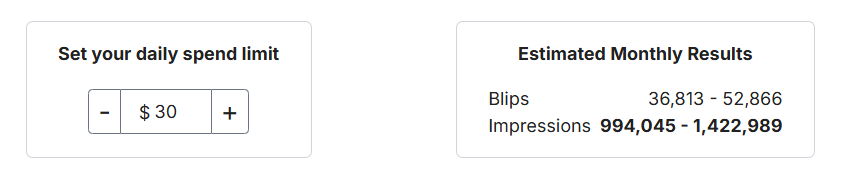
Blip allows you to bid higher during these high‑value windows while reducing or pausing spend during slower times, giving you far more control than static billboards or traditional billboard rental near Bloomington.
Crafting Effective Creative for the Bloomington Area
To stand out on high‑speed corridors near the Bloomington area, keep creative simple, bold, and locally relevant.
Best‑practice principles
- Limit to 6–8 words of main copy so drivers can absorb the message in 1–2 seconds. At 55–65 mph, a vehicle may only have 4–7 seconds in the readable zone of your ad.
- Aim for large, high‑contrast typography (e.g., white on dark blue, yellow on black).
- Use one focal image or icon, not a collage—complex imagery is harder to process at highway speeds.
- Include a simple call‑to‑action: “Exit at 494 & 24th,” “Book Today,” “Order Now.”
- Avoid clutter: keep total visual elements (logo, headline, image, CTA) to 4–5 components max.
Local relevance techniques
-
Mention recognizable landmarks and orientation points:
- “5 minutes from Mall of America”
- “Just north of I‑494 near France Ave”
- “Free shuttle from MSP hotels”
-
Reference local teams and seasons without infringing trademarks:
- “Big game weekend special – Bloomington‑area locations”
- “Beat the winter chill – spa packages near MOA”
- Use weather‑aware copy tied to local conditions (“Snow in the forecast? Service your tires today”) that you can rotate via Blip’s creative tools.
Tourist‑friendly creative
- Avoid local jargon and small text; remember that roughly 4 in 10 MOA visitors are from outside the immediate region.
-
Include:
- Clear driving references (“Next 2 exits toward Mall of America”).
- Easy web or QR‑code call‑to‑actions, especially since over 85% of travelers use smartphones to research local businesses.
- Consider multi‑language creative if you target specific visitor groups (e.g., English + Spanish or English + French for Canadian visitors).
- Highlight proximity (“3 minutes from MOA,” “Across from airport”) and convenience (“Free parking,” “Kids eat free”).
Data‑driven design choices
-
When targeting commuters on I‑494/I‑35W near Richfield:
- Use directional cues (“Next exit,” “1 mile ahead”) because many viewers are semi‑local and respond to precise navigation.
- Consider commuter‑oriented offers—such as “Service your car while you work” or “Drop off before 9, pick up after 5”—since a large share of drivers are on daily work trips.
-
When targeting tourist flows from the south via Eagan:
- Emphasize “destination branding” (photos of your venue, hotel rooms, or attractions) because many viewers may be unfamiliar with the area.
- Use trust signals like “Top‑rated in Bloomington,” especially if backed by strong reviews, as visitors often compare 3–5 options before choosing where to stay or eat.
Seasonal and Event‑Based Opportunities
The Bloomington area’s event calendar creates multiple high‑impact windows for billboard campaigns.
Using Blip Tools to Maximize ROI Near Bloomington
Digital billboards deliver their best results when we match creative, timing, and budget to real‑world patterns. This is especially true when you’re treating these locations as your core billboard advertising near Bloomington.
1. Start with a clear geographic strategy
-
Use Richfield‑area boards to:
- Catch Bloomington‑area commuters heading to and from Minneapolis and MSP, where daily vehicle counts can exceed 100,000 on key segments.
- Promote businesses located along I‑494 and I‑35W corridors, including auto dealers, medical campuses, and corporate offices.
-
Use Eagan‑area boards to:
- Reach Dakota County residents heading toward MOA and the Bloomington area, especially via I‑35E, Highway 13, and Cedar Avenue.
- Promote destinations and services that are convenient from both Eagan and Bloomington, such as hotels, family attractions, and big‑box retail.
Together, these placements function as a de facto network of Bloomington billboards without requiring you to lock into a traditional local lease.
2. Dayparting and budget allocation
- Allocate 40–50% of impressions to weekday rush hours if you’re a service‑oriented business (healthcare, financial, B2B, home services), as these windows deliver consistent, high‑frequency exposure to working adults.
- Shift spend to weekend and evening blocks if you’re in dining, entertainment, retail, or hospitality, when MOA and destination traffic peaks.
-
Use smaller test budgets first, then:
- Identify which days/times produce the strongest lifts in website visits or store traffic (for example, you might see 20–30% higher web sessions during time blocks when your billboards run).
- Increase bids for those windows while dialing down low‑performing periods to improve return on ad spend.
3. A/B test multiple creatives
Because Blip charges per “blip” (each play of your ad), you can rotate creatives to learn what works:
-
Test different:
- Headlines (“Save 20% this weekend” vs. “Bloomington‑area’s Best Family Fun”).
- Images (product shot vs. happy family vs. location exterior).
- Calls‑to‑action (“Book online” vs. “Call today” vs. “Exit 1 mile”).
- Aim for at least 2–4 creatives per campaign so you can compare performance.
-
Measure performance using:
- Google Analytics spikes in sessions from the Bloomington/Richfield/Eagan area.
- Offer codes unique to billboard creative.
- Changes in foot traffic or call volume aligned with campaign times, especially if you see same‑day or next‑day lifts when your messages run.
4. Align with digital campaigns
-
Pair Blip boards serving the Bloomington area with:
- Geo‑targeted search and social ads focused on Bloomington, Richfield, Eagan, and nearby ZIPs.
- Consistent imagery and taglines so viewers recognize you across channels; cross‑channel consistency has been shown in many campaigns to lift brand recall by 20–30%.
-
Many advertisers see stronger performance when outdoor impressions are supported by retargeting or branded search:
- Someone who sees your message on I‑494 is more likely to click your ad later; blended campaigns can drive higher click‑through and conversion rates than digital‑only efforts.
- Use local media coverage—via outlets like the Star Tribune, KSTP 5 Eyewitness News, KARE 11, or WCCO—to time campaigns around economic development, new openings, or major regional stories that affect travel and shopping patterns.
Industry Examples That Perform Well in the Bloomington Area
Based on the Bloomington area’s demographics and travel/tourism flows, certain verticals tend to see outsized value from digital billboards:
-
Hotels and lodging
- Compete for MOA and MSP visitors with “Park & Fly,” free breakfast, or shuttle messaging. Bloomington’s 9,000+ hotel rooms are heavily influenced by online searches plus roadside signage, so visibility along I‑494/Highway 77 is critical.
- Use precise time windows around flight arrival peaks—for example, early‑evening international arrivals and late‑night domestic flights—to promote last‑minute bookings and “Tonight only” rates.
-
Dining and entertainment
- Family‑friendly restaurants, breweries, dessert shops, and attractions can target MOA and I‑494 traffic. With MOA drawing tens of thousands of diners per day, even a small share diverted off the main campus can meaningfully impact sales.
- Promote “Kids eat free,” “Happy hour,” or “Late‑night bites” with daypart‑specific creatives. Data from many casual‑dining chains show 20–40% sales lifts during happy hour when supported by targeted local advertising.
-
Retail and services
- Furniture, home improvement, big‑box, and specialty retailers near the Bloomington area can capture shoppers already primed to spend; MOA shoppers have above‑average basket sizes and higher-than-average dwell times (3–4 hours), indicating strong purchase intent.
- Seasonal pushes (tax refunds in spring, back‑to‑school, holiday shopping) work extremely well. Retailers often see double‑digit percentage increases in traffic when pairing event‑ or season‑based offers with high‑visibility billboards.
-
Healthcare and wellness
- Urgent cares, dental practices, physical therapy, and specialty clinics serving Bloomington‑area families can build brand trust and name recognition. Healthcare decisions are often influenced by brand familiarity and perceived proximity, both of which billboards support.
- Simple “Same‑day appointments near MOA – [Brand Name]” messages work effectively, especially when targeted during weekday daytime hours and early evenings.
-
Auto sales and service
- High vehicle traffic on I‑494 and I‑35 corridors makes billboards perfect for brand awareness. Local dealerships often rely on regional draw, with buyers traveling 20–40 miles for the right deal.
- Feature limited‑time offers or “Service while you shop” near MOA; many shoppers are open to combining errands, and a clear offer can drive incremental service appointments during peak shopping seasons.
These examples all benefit from cost‑efficient billboard rental near Bloomington that can be dialed up or down as seasons, promotions, and inventory levels change.
Local Resources and Compliance Considerations
Outdoor advertising near the Bloomington area is governed primarily at the state and municipal level.
- The City of Bloomington and neighboring cities publish zoning codes and sign ordinances. While Blip and our billboard partners handle compliance for our digital faces, it’s useful to understand local sensitivities about brightness, motion, and content—especially as some municipalities restrict dwell time, animation, and nighttime luminance levels.
- Richfield and Eagan have their own sign regulations, available from the City of Richfield and City of Eagan. These may govern on‑premise digital signs you operate in addition to off‑premise Blip boards.
-
The Minnesota Department of Transportation regulates signage along state and federal highways, particularly I‑494, I‑35W, and Highway 77. Our inventory complies with those standards, but advertisers should avoid:
- Mimicking official traffic signs.
- Using rapidly flashing or strobe‑like effects.
- Misleading or unsafe content, such as claims easily interpreted as traffic warnings.
- For tourism and visitor behavior insights, the Bloomington Convention & Visitors Bureau Meet Minneapolis provide data on visitor volumes, major events, and hotel performance that can help you plan campaign timing and messaging.
For local news context, trends, and audience insights, outlets like the Star Tribune and KSTP 5 Eyewitness News provide ongoing coverage of economic development, traffic changes, and major events that can inform your campaign timing and messaging.
Putting It All Together
To succeed with digital billboards serving the Bloomington area:
- Define your primary audience (residents, commuters, tourists, shoppers) based on the dynamics above, including their income levels, travel habits, and peak times on the road.
- Choose boards strategically in Richfield and Eagan to intercept those audiences on their natural routes, focusing on corridors with 80,000–150,000 vehicles per day and effectively turning these locations into high‑impact billboards near Bloomington.
- Match creative and schedule to the strongest traffic windows: rush hours for commuters, weekends/evenings for shoppers and families, and event‑driven bursts around MOA activities, conventions, and major games or concerts.
- Keep designs bold and minimal, emphasize local landmarks like Mall of America and MSP, and provide clear calls‑to‑action grounded in distance (“2 minutes from MOA”) and convenience (“Free parking,” “Exit now”).
- Iterate with data, using Blip’s flexibility to adjust bids, rotate creatives, and target specific days and times, while monitoring website traffic, call volume, and in‑store visits from Bloomington‑area ZIP codes.
By combining the Bloomington area’s unique mix of tourism, commerce, and stable suburban households with Blip’s pay‑per‑play model, we can help you build campaigns that are both highly visible and tightly efficient. This approach to billboard advertising near Bloomington turns the region’s busiest corridors into a reliable growth engine for your business, without the long‑term commitments that usually come with traditional Bloomington billboards.