Understanding the Columbia Heights Area Audience
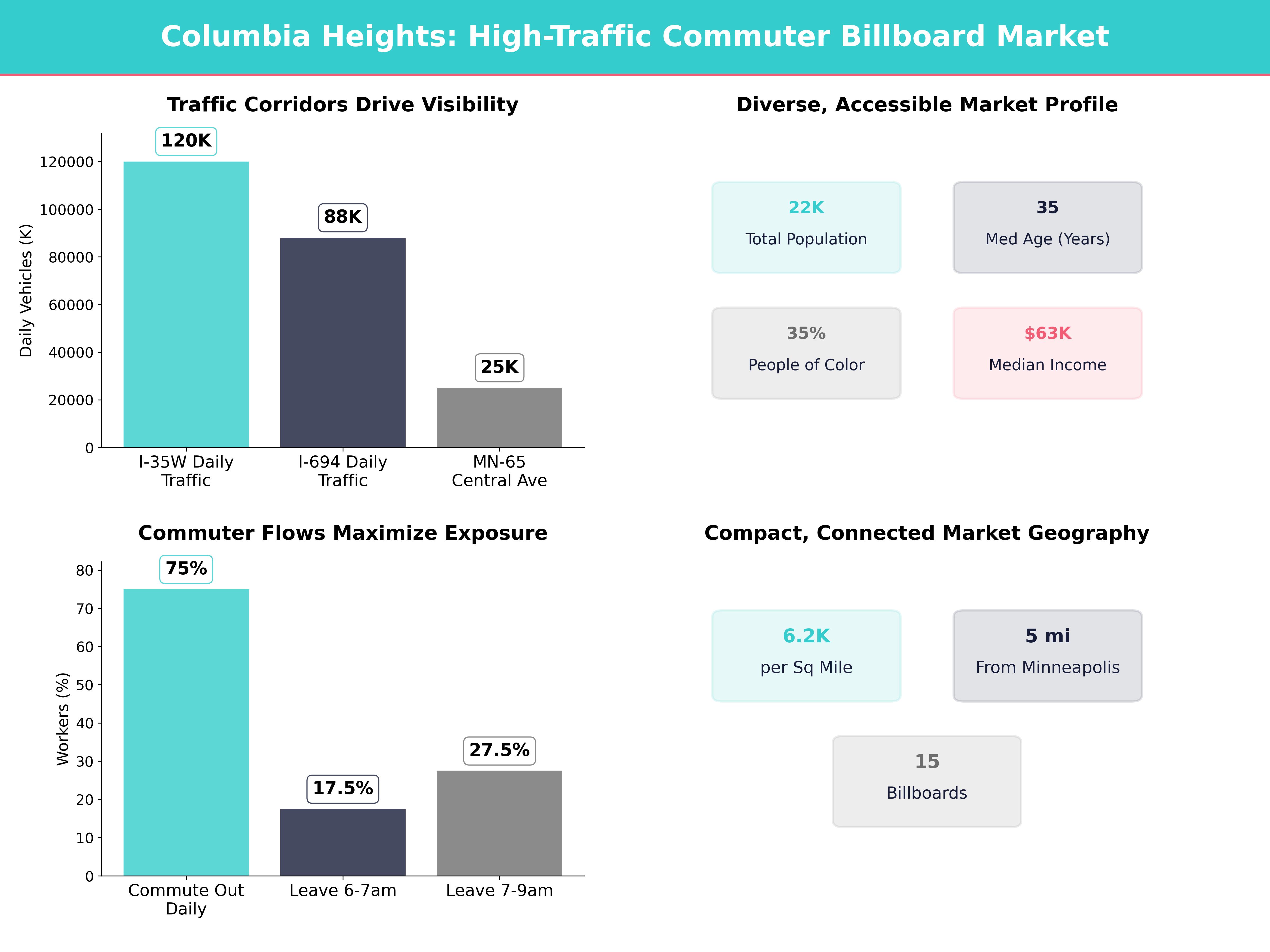
Columbia Heights is a compact, highly connected inner-ring suburb with roughly 22,000 residents in 3.5 square miles, giving it a population density of about 6,200 people per square mile, one of the higher densities in the north metro. According to recent city and regional planning data referenced by the City of Columbia Heights, Anoka County, and the Columbia Heights Public Schools:
-
Young and working-age:
- Median age is around 34–35 years.
- Roughly 65–70% of residents are 18–64 (working-age).
- Children under 18 account for about 22–25%, supporting strong demand for youth- and family-focused services.
-
Highly diverse: While numbers shift year to year, local and school district data show a mix of approximately:
- 55–65% White
- 15–20% Black or African American
- 10–15% Hispanic/Latino
- 5–10% Asian
- Plus growing multiracial and immigrant communities, with some neighborhood schools reporting 40%+ students of color and 20–30% of students speaking a language other than English at home.
-
Income and housing mix: City and county profiles indicate:
- Median household income in the Columbia Heights area is roughly $60,000–$65,000, a bit below the broader Twin Cities metro median.
- Owner-occupancy is around 55–60%, with 40–45% renter households, higher than many outer suburbs.
- About 30–35% of households are cost-burdened (spending 30%+ of income on housing), making value-oriented offers compelling.
-
Commuter suburb with strong regional ties:
- A large share of workers travel to jobs in Minneapolis, New Brighton, Blaine, and other nearby employment centers.
- The city sits less than 5 miles from downtown Minneapolis and is adjacent to major arterials like Central Avenue NE (MN-65) and University Avenue NE (MN-47).
What this means for billboard advertisers:
- Broad, mainstream appeal works well, but we should avoid one-size-fits-all imagery. Diverse representation and inclusive language in creative will resonate strongly in a community where 30–40%+ of residents are people of color and many households are multilingual.
- Value-oriented messaging (affordable services, deals, local convenience) fits an income profile where a substantial share of households are middle-income or budget-conscious.
- Because so many residents commute to and from Minneapolis and the northern suburbs, placing creative near those commute routes via our Minneapolis, New Brighton, Spring Lake Park Blaine boards is particularly effective—these routes intersect tens of thousands of daily trips linked to Columbia Heights, making these Columbia Heights billboards highly efficient for local and regional brands.
For more local context and events that shape daily life, it’s worth following the City of Columbia Heights news and events and local coverage from outlets like the Star Tribune, KSTP 5 Eyewitness News, and the Sun Focus, which regularly covers Columbia Heights and nearby communities.
Where Our 15 Billboards Reach Drivers Near Columbia Heights
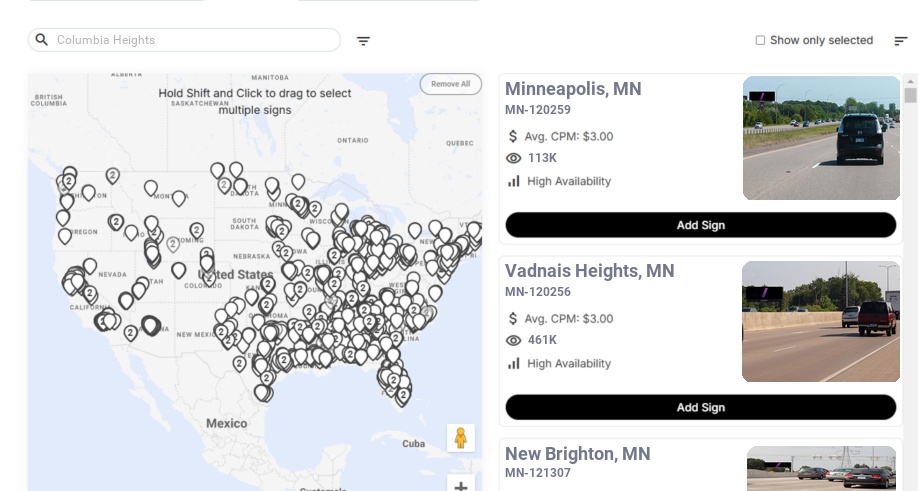
Our 15 digital billboards serving the Columbia Heights area are distributed across nearby cities within about 10 miles, giving advertisers easy access to billboards near Columbia Heights without having to commit to a single fixed location:
These boards sit along major commuter and shopping corridors that Columbia Heights residents regularly use. According to traffic counts from the Minnesota Department of Transportation (MnDOT)
- I-35W near New Brighton carries roughly 110,000–130,000 vehicles per day (AADT), which equates to 40–47 million vehicle trips per year on a typical segment.
- I-694 just north of Columbia Heights sees around 80,000–95,000 vehicles per day, or about 29–35 million vehicle trips per year.
- MN-65 (Central Avenue NE), a key north–south route bordering Columbia Heights, can carry 20,000–30,000 vehicles per day depending on the segment—7–11 million trips annually.
- MN-47 (University Avenue NE) and local arterials feeding into Minneapolis also see strong daily traffic volumes in the 15,000–30,000 vehicles per day range on many segments.
By placing campaigns on boards near these corridors, we effectively intersect:
- Daily commuters: Regional planning data from the Metropolitan Council indicate that in inner-ring suburbs, 70–80% of employed residents leave their home city for work. For Columbia Heights, that translates to an estimated 7,000–8,000 outbound commuters each weekday, much of it funneling through I-35W, I-694, Central Avenue, and University Avenue.
- Regional shoppers: Retail hubs such as Northtown Mall in Blaine, the commercial strips along Central Avenue in Columbia Heights and Fridley, and big-box clusters in New Brighton and Spring Lake Park pull tens of thousands of weekly visits from the north metro. MnDOT data show that key retail approaches around Blaine and Spring Lake Park typically exceed 25,000 vehicles per day.
- Recreation and event traffic: Minneapolis is a regional magnet. Tourism data from Meet Minneapolis show the city hosts millions of visitors annually and major events—sports, concerts, and festivals—regularly draw daily attendance in the tens of thousands, increasing evening and weekend traffic on freeways and principal arterials.
Blip allows us to choose specific signs and times, so we can:
- Prioritize boards on east–west and north–south commuter routes during peak rush hours, when MnDOT data show that 30–40% of daily traffic volume often occurs in the combined morning and evening commute windows.
- Use Blaine and Spring Lake Park boards to reach families visiting regional retail and youth sports complexes like the National Sports Center, which can host tournaments bringing 10,000–20,000+ visitors on busy weekends.
- Leverage Minneapolis boards for branding that reinforces a Columbia Heights-area business to workers already heading north toward home.
For context on nearby destinations and visitor activity, you can also reference city information from Blaine, New Brighton, and Spring Lake Park when planning billboard advertising near Columbia Heights.
Commuting Patterns and Dayparting Strategy
The Columbia Heights area is classic “live here, work there” suburbia, with a high share of outbound commuters. Regional planning data from the Metropolitan Council show that across inner-ring suburbs like Columbia Heights:
- A large majority (often 70%+ of employed residents) commute out of their home suburb to work, with Minneapolis and nearby employment centers such as New Brighton and Blaine as primary destinations.
- Average commute times in the north metro sit near the 25–30 minute mark, and over 75% of workers commute by car, truck, or van, underscoring the importance of freeway- and arterial-facing advertising.
- In many north metro communities, 15–20% of workers leave for work between 6–7 a.m., and another 25–30% between 7–9 a.m., creating strong morning peaks.
When we align billboard schedules with these patterns, we maximize every dollar:
Weekday Morning (6–9 a.m.)
- Focus on Minneapolis- and New Brighton-area boards along I-35W, I-694, and connecting routes, where combined morning flows can exceed 30,000–40,000 vehicles over the three-hour window on busy segments.
- Target workers heading south into Minneapolis and north/east into office parks and industrial areas.
-
Best for:
- Coffee shops, breakfast spots, convenience stores
- Transit park-and-ride promotions (supported by Metro Transit park-and-ride usage in the tens of thousands of daily riders regionwide)
- Professional services (dental, healthcare, financial) with strong call-to-action: “Call before work,” “Schedule on your lunch break”
Weekday Midday (10 a.m.–3 p.m.)
- Midday traffic is lower than peak, but still substantial—often 35–45% of daily volume passes during off-peak hours, with more discretionary trips.
-
Good time to reach:
- Stay-at-home parents
- Remote and hybrid workers running errands
- Older adults and shift workers
-
Rotate creative to emphasize:
- Retail sales and grocery
- Healthcare appointments, local clinics
- Home services (HVAC, roofing, lawn care)
- Use boards across Minneapolis, New Brighton, and Blaine to blanket everyday errand routes.
Weekday Evening (3–7 p.m.)
- On many Twin Cities corridors, evening peak-hour volumes meet or exceed morning peaks, with outbound traffic often representing 20–25% of total daily volume in just a few hours.
- Capture commuters heading back toward the Columbia Heights area from Minneapolis and northern employment centers.
-
Ideal for:
- Restaurants and bars (“Dinner on your way home”)
- Gyms and fitness centers (“Stop in tonight”)
- After-school programs, tutoring, and youth sports
- Heavy emphasis on northbound and westbound directions—where drivers are returning home.
Evenings and Late Night (7–11 p.m.)
- Traffic volumes decrease, but there is a higher share of discretionary trips for entertainment, dining, and retail.
-
Great for:
- Entertainment venues in Minneapolis
- Streaming services, local events, nightlife
- Lower cost per blip in many cases, allowing more impressions for brand-building and frequency.
Weekends
- Traffic patterns shift toward shopping and recreation. Studies from regional transportation agencies show that on weekends, up to 50% of trips can be shopping, social, or recreational, versus work.
- Retail corridors in Blaine, Spring Lake Park, and New Brighton often see strong Saturday peaks similar to weekday rush volumes.
-
Use weekends to:
- Promote events, festivals, and faith communities in the Columbia Heights area
- Drive traffic to local breweries, family attractions, and restaurants
- Push limited-time retail promotions when families are out shopping
With Blip, we can daypart precisely—buying only the times that matter most to your audience instead of paying for low-value hours, which makes our Columbia Heights billboards more cost-effective than traditional all-day buys.
Tapping Into Local Events and Seasonality
Columbia Heights has a steady calendar of civic events, youth activities, and regional happenings that shape traffic and attention. The City of Columbia Heights events calendar and regional tourism sites like Meet Minneapolis are invaluable planning tools, as are regional listings from Explore Minnesota.
Seasonal opportunities:
-
Winter (Dec–Feb)
- Twin Cities climate data show average high temperatures often below freezing, with 30+ days per season where snowfall or icy conditions affect driving. Shorter daylight hours (sunset as early as 4:30 p.m. in December) mean rush hour happens in the dark, so bold, high-contrast creative is essential.
-
Good time for:
- Auto service (tires, brakes, batteries)
- Home heating and energy services
- Indoor recreation, gyms, and arts programs
-
Spring (Mar–May)
- As snow recedes, MnDOT records typically show gradual increases in traffic volumes and more discretionary trips. Home improvement spending also tends to spike regionally in this period.
-
Peak for:
- Home improvement and landscaping
- Real estate (listings, new developments near Columbia Heights)
- Summer camp registrations and youth programs promoted through Columbia Heights Recreation and local schools
-
Summer (Jun–Aug)
- Long daylight hours (sunset near 9:00 p.m. in June) maximize billboard visibility and extend effective viewing into late evening.
- High travel to regional lakes, parks, and youth sports complexes in Blaine and surrounding cities; events at the National Sports Center and Minneapolis parks can draw thousands to tens of thousands of participants and spectators on peak days.
-
Ideal for:
- Festivals, fairs, and block parties in the Columbia Heights area (such as the city’s summer celebrations promoted on the events calendar)
- Outdoor dining, ice cream, and local attractions
- Tourism and staycation offers tied to Minneapolis and north metro amenities
-
Fall (Sep–Nov)
- Back-to-school and holiday-prep shopping kick in. School-year start dates for Columbia Heights Public Schools and nearby districts create clear advertising windows for youth programs and family services.
-
Strong for:
- Education services, tutoring, and youth programs
- Healthcare checkups and vaccinations (flu season and back-to-school requirements)
- Retail promotions leading into the holidays
With Blip’s flexibility, we can:
- Ramp up spend around major city events, sports tournaments, and school-year transitions—for example, increasing impressions during Columbia Heights’ major community festivals or around big downtown Minneapolis events listed by Meet Minneapolis.
- Schedule short, intense bursts of impressions for limited-time fairs, fundraisers, or community events, targeting the exact week or weekend.
- Turn campaigns on/off within days, aligning exactly with event dates and weather-sensitive offerings.
Creative Best Practices for the Columbia Heights Area
Given the commuter-heavy and culturally diverse audience near Columbia Heights, artwork should be:
1. Bold, Simple, and Fast
Most drivers on I-35W, I-694, Central Avenue, and University Avenue have only 6–8 seconds to absorb a message. Research on out-of-home effectiveness commonly shows that creative with fewer than 8–10 words delivers significantly higher recall.
We recommend:
- 6–8 words maximum of main copy.
- One clear call-to-action (e.g., “Exit on Central Ave,” “Book at [short URL]”).
- Large fonts (without thin strokes) and strong contrast, especially for winter evenings when more than half of weekday commuter trips can occur in twilight or darkness.
- High-impact imagery—avoid clutter and tiny details.
2. Locally Grounded
People identify strongly with neighborhoods and nearby cities. Consider:
- Using phrases like “Near Central Ave,” “Just minutes from Columbia Heights,” or “North metro locations.”
- Highlighting recognizable landmarks or corridors (Central Ave, University Ave, I-35W/I-694, Northtown Mall, or downtown Minneapolis skyline).
- Featuring local customers, staff, or recognizable community scenes to build authenticity—especially when targeting a community where 60–70% of residents live and work within the broader north metro, and where billboards near Columbia Heights are part of daily routines.
3. Inclusive and Community-Oriented
In a diverse community like the Columbia Heights area:
- Use imagery representing different ages, ethnicities, and family types to reflect a local population where roughly one in three to one in two residents may be non-white or multiracial, depending on the neighborhood.
- Keep language straightforward and accessible, avoiding jargon.
- If you offer multilingual services, a simple note like “Se habla español” or “Hablamos Somali” can be powerful—just keep it short and legible and consider that 10–20%+ of residents may speak a language other than English at home.
4. Offer-Driven When Appropriate
Data from many campaigns across the metro and national OOH studies indicate that:
- Clear offers (“$9.99 oil change,” “50% off first month,” “Free estimate”) often outperform vague branding assertions, often boosting response rates by 20–50% compared with generic awareness messages.
- Time-limited messages (“This week only,” “Ends Sunday”) help convert impressions into immediate action and can create short-term sales lifts.
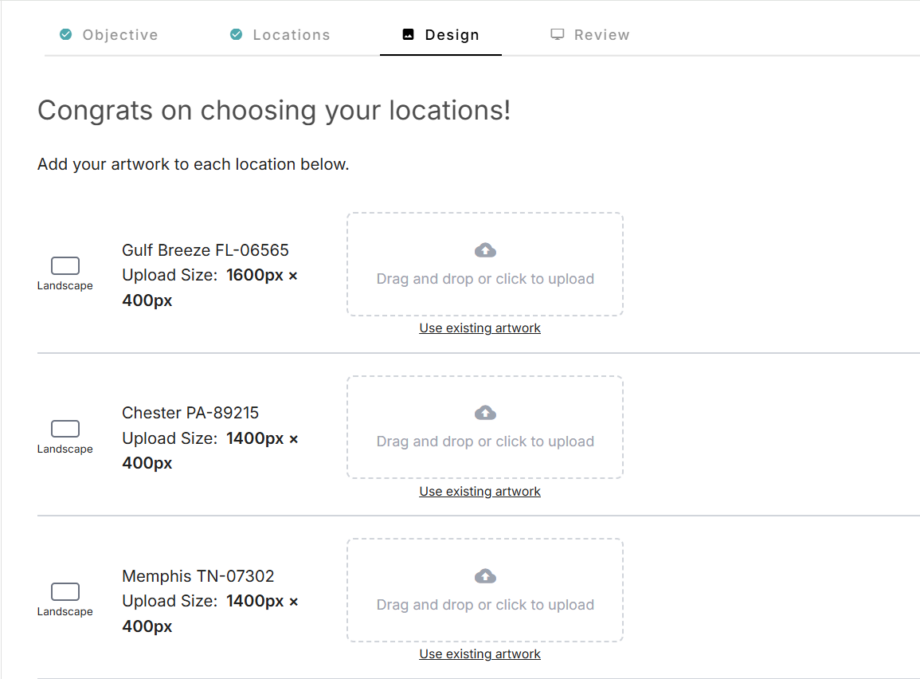
Because Blip allows unlimited creative rotation at no extra media cost, you can test multiple variations:
- One board set pushing a price offer
- Another highlighting location convenience
- A third pushing community involvement (sponsorships, events)
Then track which themes align with upticks in calls, web traffic, or in-store visits.
Using Blip’s Flexibility to Target the Columbia Heights Area
Blip’s pay-per-blip model and scheduling tools are especially well-suited to a compact, cross-commuting market like Columbia Heights. If you’re exploring billboard advertising near Columbia Heights for the first time, this flexibility makes it easy to start small and scale up. We can:
Target by Corridor
- Focus budget on signs along I-35W and I-694 to reach regional commuters; combined, these corridors near Columbia Heights connect to hundreds of thousands of daily trips.
- Layer in boards near Blaine and Spring Lake Park to reach youth sports traffic and major retail, especially on weekends when tournament and shopping traffic surges.
- Add Minneapolis boards for two-way reinforcement: residents leaving or returning to the Columbia Heights area, as well as urban dwellers who travel to the north metro for shopping, entertainment, or services.
Target by Time of Day
- Concentrate spend during morning and evening rush hour, when MnDOT data show that roughly half of daily freeway traffic commonly occurs.
- Use off-peak hours to reach specific segments (stay-at-home parents, retirees, night-shift workers) at lower effective rates, increasing frequency without necessarily increasing budget.
Scale Budget Up or Down
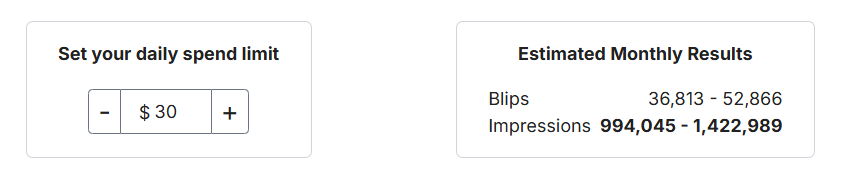
- Start with a modest daily budget to gather baseline performance data—e.g., enough impressions to consistently show several times per hour on key boards.
- Increase budget during big promotions, store openings, or event weeks when conversion potential is highest.
- Pause or reduce spend instantly if your phones or capacity are maxed out, or when seasonality drops demand, giving you more control than traditional billboard rental near Columbia Heights.
Rotate Creative Strategically
-
Run different creatives at different times:
- Morning: “Stop on your way to work”
- Evening: “Dinner tonight?”
- Weekend: “Family fun this weekend”
- A/B test headlines, colors, and offers to see what drives the most engagement; even a 10–20% improvement in response rate can significantly increase ROI at the same spend level.
Industry-Specific Tips for the Columbia Heights Area
While every business is unique, some sectors can leverage specific local dynamics when using Columbia Heights billboards.
Local Restaurants, Cafés, and Breweries
- Use boards along I-694 and Central Ave corridors near Columbia Heights plus Minneapolis to capture both commuters and weekend diners. Columbia Heights and nearby neighborhoods have thousands of workers and residents within a 5–10 minute drive, making “nearby” offers powerful.
-
Feature:
- Distance-based calls (“5 minutes from this exit,” “2 miles north on Central”)
- Daily specials or happy hours, rotating creatives by time of day
-
Consider dayparting:
- Morning: breakfast/coffee
- Afternoon: lunch deals
- Evening: dine-in and takeout, with stronger calls on Thursday–Sunday when restaurant traffic typically peaks.
Home Services (Roofing, HVAC, Plumbing, Landscaping)
- The housing stock in and around Columbia Heights includes many mid-century homes built in the 1950s–1970s, which are prime for maintenance and upgrades (roof replacement cycles of 20–30 years, furnaces and AC units often replaced after 15–20 years).
- Run campaigns heavily in spring and fall, when demand for exterior and HVAC services peaks and when heating and cooling tune-up offers are most relevant.
-
Emphasize:
- Service radius (“Serving the Columbia Heights area and north metro”)
- Fast response times and strong local reviews
- Focus on commuter routes from Minneapolis so homeowners see your ads daily on their way to and from work.
Healthcare, Dental, and Vision
- The short drive times between Columbia Heights and New Brighton, Blaine, and Minneapolis (often 10–15 minutes via freeway or major arterials) mean patients are willing to travel a few miles for care.
-
Use:
- Trust-focused messaging (“Family care close to home,” “Same-week appointments”)
- Simple calls to action (short URL or direct phone)
-
Daypart to hit:
- Early mornings (Scheduling on the way to work; many clinics open by 7–8 a.m.)
- Evenings (Reminders when people are planning the week; highlight extended hours if available)
Retail, Fitness, and Franchises
-
For gyms, big-box stores, and specialty retail, combine:
- Blaine/Spring Lake Park boards for shoppers near Northtown Mall and big-box corridors
- Minneapolis/New Brighton boards for commuters who pass your locations daily
-
Rotate seasonal offers:
- New Year fitness promos (when national gym signups often spike 20–30% above typical months)
- Back-to-school sales (late August–September)
- Holiday shopping events (Nov–Dec, when regional retail sales surge)
-
Emphasize:
- Easy parking and quick access from main roads
- “Open late” or “Open early” for commuters.
Community Organizations, Schools, and Faith Communities
- The Columbia Heights area is community-oriented with active schools, churches, and nonprofits. Columbia Heights Public Schools alone serve thousands of students, and local congregations and civic groups reach thousands more.
-
Use Blip to:
- Promote registration deadlines (school programs, sports, camps)
- Advertise special services, concerts, and holiday events
- Showcase community impact (“Serving local families since 19XX”)
-
Time campaigns to align with:
- Start of school terms and major breaks
- Major holidays and community celebrations highlighted on the city’s events calendar
- Weekend services or event dates
Measuring, Learning, and Improving Over Time
To get the most from campaigns reaching drivers near Columbia Heights, we should track performance and refine:
Use Clear Tracking Mechanisms
- Custom URLs or landing pages referenced only on billboards, allowing you to quantify visits attributable to OOH.
- Unique phone numbers or extensions for billboard responders; even a few dozen trackable calls per month can demonstrate strong ROI at local budgets.
- “Mention this billboard for X” offers tracked at point of sale, so staff can tally responses.
Monitor by Time and Geography
-
Compare response volumes when you are:
- Heavier on rush-hour dayparts vs all-day coverage.
- Concentrated on north metro boards vs more Minneapolis-centric.
- Adjust bids and schedules in Blip based on these patterns, reallocating impressions toward the locations and times that produce the most calls, website visits, or store traffic.
Align With Local News and Conditions
- During severe weather, construction, or local news events, traffic flows and concerns change. Winter storms or major construction projects can alter patterns on I-35W, I-694, and Central Avenue for weeks at a time.
-
Stay aware through sources like:
- Adjust copy to acknowledge delays, weather, and seasonal concerns where appropriate (e.g., winter safety checks, construction detours, or event-specific messaging).
By combining an understanding of the Columbia Heights area’s demographics, commute patterns, and community identity with Blip’s flexible, data-driven platform, we can build campaigns that punch far above their budget. Strategic placement on our 15 digital billboards in Minneapolis, New Brighton, Spring Lake Park, and Blaine—combined with smart timing and tailored creative—allows advertisers to consistently and efficiently reach the people who live, work, and shop near Columbia Heights with targeted billboard advertising near Columbia Heights that fits almost any budget.