Understanding the Hopkins, Minnesota Market
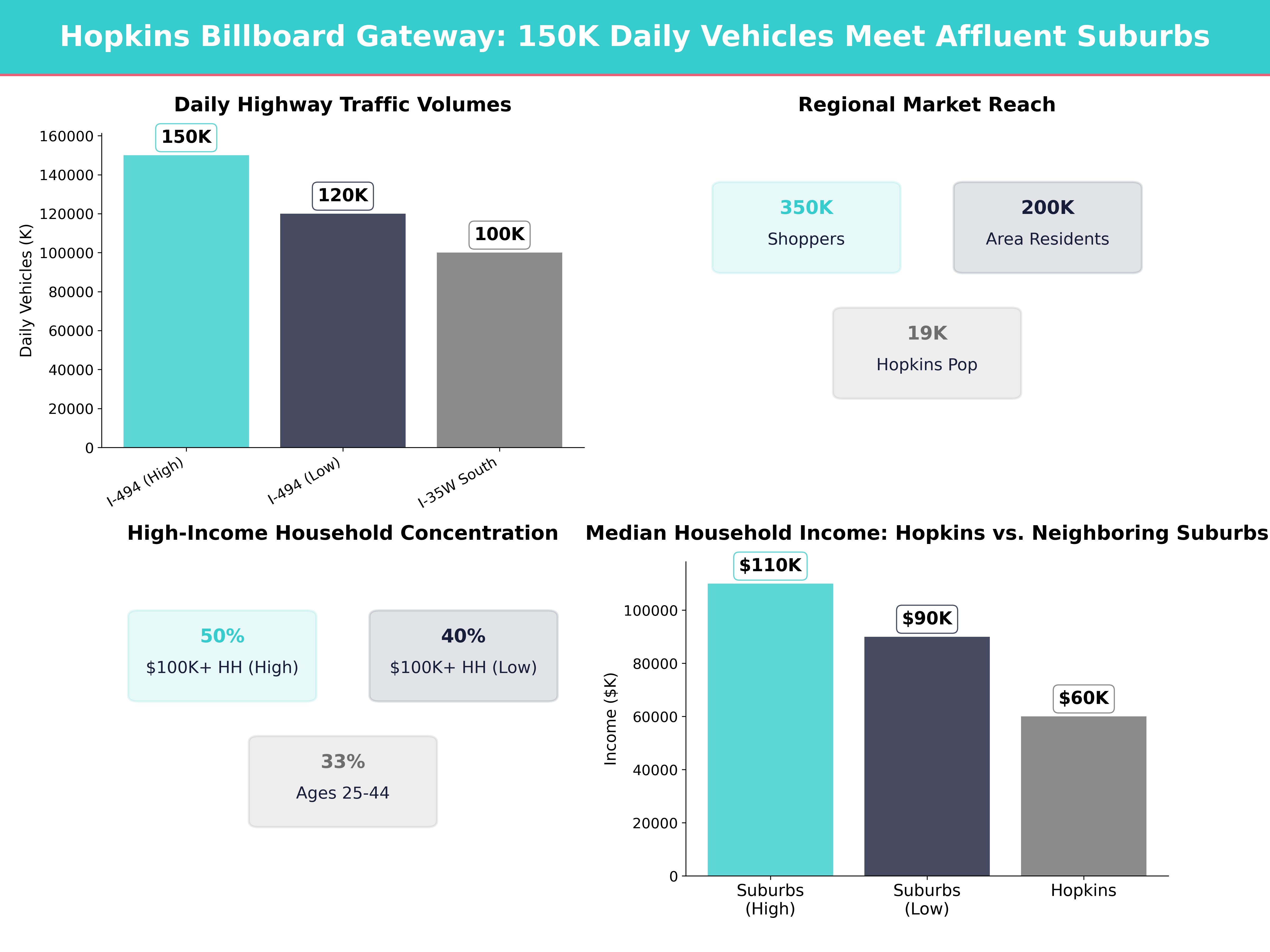
Hopkins is a compact but influential city in Hennepin County, with a 2020 population of 19,079 and continued modest growth estimates since then. Within the broader southwest metro (Hopkins, Minnetonka, St. Louis Park, Edina, Richfield, and neighboring communities), the immediate trade area easily exceeds 200,000 residents, and the west‑metro catchment for daily shopping and services runs well above 350,000. For advertisers, this makes billboard advertising near Hopkins an effective way to reach both local households and a much larger commuter and shopper audience that moves through the area every day.
Key demographic and economic highlights for the Hopkins area:
- Population density: Hopkins covers just 4.1 square miles, translating to roughly 4,650 people per square mile—much denser than many nearby suburbs and over 3x the statewide average density. This density helps maximize impressions per advertising dollar because a relatively small geographic footprint generates tens of thousands of daily trips.
-
Age profile: The median age in Hopkins is around 32–33, younger than the Minnesota statewide median of roughly 38. In practice, that means:
- Close to 1 in 3 residents are in the key 25–44 working‑age bracket.
- A solid share of households are in “formation” years—first apartments, first homes, and young children—when spending on housing, furnishings, childcare, and services is especially high.
-
Household income: Median household income in Hopkins sits in the low‑to‑mid $60,000s, but the surrounding suburbs (Minnetonka, Edina, Eden Prairie) push well into the $90,000–$110,000+ range. Within a 10–15‑minute drive of Hopkins, it’s common for 40%–50% of households to earn $100,000 or more annually. This mix supports:
- Value‑oriented messaging aimed at Hopkins renters and first‑time buyers.
- Premium or aspirational messaging aimed at higher‑income households nearby, including luxury auto, medical, and home‑remodeling services.
-
Housing mix: Hopkins has a relatively high share of renters compared with many suburbs, with roughly half of occupied housing units renter‑occupied versus about one‑quarter to one‑third in many nearby communities. That means more frequent moves and life transitions—ideal for:
- Apartment communities and property managers
- Furniture, home goods, and moving/storage services
- Financial institutions and insurance providers
- Employment and education: The southwest metro is one of the Twin Cities’ most educated and employed regions, with nearby cities like Minnetonka, St. Louis Park, and Edina each showing well over 40% of adults holding a bachelor’s degree or higher and unemployment rates often in the 3%–4% range. This supports strong discretionary spending on dining, travel, and wellness.
Locally, the City of Hopkins and Hennepin County share useful public data, community plans, and event calendars that can inspire highly relevant, time‑sensitive campaigns. Regional context and visitor trends are also covered by organizations like Meet Minneapolis, Discover St. Louis Park Hopkins Business & Civic Association
Who You Can Reach Near Hopkins with Digital Billboards
Because Hopkins is tightly integrated into the Twin Cities job and retail market, digital billboards near Hopkins give you access to several high‑value audience segments across a metro area of roughly 3.7 million residents:
- Commuters: A large portion of Hopkins residents commute to jobs in Minneapolis, St. Louis Park, Minnetonka, Bloomington, and other suburbs. Pre‑pandemic regional data showed roughly 70%–75% of workers in the metro driving alone to work and another 8%–10% carpooling. Even with hybrid work, traffic volumes on I‑494 and I‑35W have returned to a substantial share of pre‑2020 levels, keeping daily vehicle counts in the six‑figure range on major segments.
-
Retail and service shoppers: Hopkins is just minutes from major retail nodes like Ridgedale, Southdale, and the West End, as well as local Mainstreet Hopkins
- From work to errands (weekday evenings)
- From home to weekend activities (Saturday–Sunday daytime)
- Families and youth activities: Hopkins Public Schools serves more than 6,000 students across the district, and youth‑oriented programs bring in students from several neighboring cities. Add in club sports, parks and recreation programming curated by Hopkins-Minnetonka Recreation Services Hopkins Center for the Arts, and regional tournaments, and you have steady family traffic year‑round, especially during after‑school (3–6 p.m.) and weekend hours.
- Event‑driven visitors: Community events such as the Hopkins Raspberry Festival—one of Minnesota’s longest‑running community festivals, drawing many thousands of visitors each July—concerts, art fairs, and seasonal celebrations attract visitors from around the metro. These visitors travel through major corridors where our Richfield billboards can influence last‑minute decisions on dining, shopping, and entertainment. Event listings from the Hopkins Raspberry Festival, City of Hopkins, and local venues help identify peak visitor windows.
By aligning your messaging with these audience patterns, we can make sure your brand shows up at the right moments near the Hopkins area and that billboards near Hopkins are working as an integral part of your overall media mix.
Where Our Billboards Are Located and Traffic Patterns
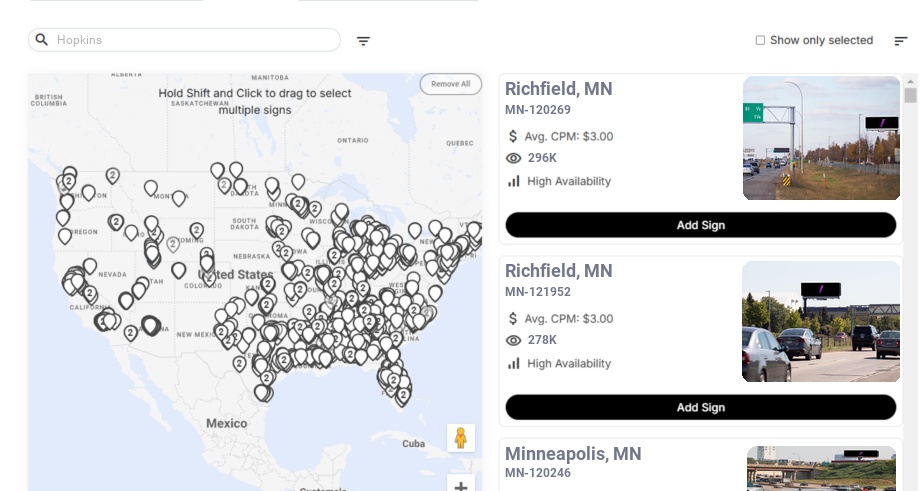
Blip currently operates 3 digital billboards serving the Hopkins area, all in nearby Richfield (about 8.5 miles away). While exact panel placement can vary, they typically sit along high‑traffic corridors like I‑494, I‑35W, and key surface arterials—roads that Hopkins‑area residents routinely use to reach:
- The Minneapolis–St. Paul International Airport (over 30 million passengers in a typical year), managed by the Metropolitan Airports Commission
- Mall of America, one of the most visited shopping and entertainment destinations in the U.S., attracting tens of millions of visits annually, in Bloomington
- Major employers in Bloomington, Richfield, Minneapolis, and Edina, including corporate campuses for companies such as Best Buy, Target, and major healthcare systems
- Regional shopping and healthcare destinations across Richfield, Bloomington, and Edina
To get a sense of traffic scale, based on counts published by the Minnesota Department of Transportation (MnDOT):
- Segments of I‑494 in the south metro carry on the order of 120,000–150,000 vehicles per day.
- Segments of I‑35W south of downtown Minneapolis routinely see 100,000+ vehicles per day.
- Major surface routes in Richfield (such as Lyndale Ave S, Penn Ave S, and 66th Street) each add tens of thousands of additional daily vehicles, with key intersections regularly exceeding 20,000–30,000 vehicles per day.
Many of these drivers either live in the Hopkins area or frequently travel to and from it—whether they are commuting from Hopkins toward employers in Bloomington and Minneapolis, heading to the airport, or visiting destinations like Wood Lake Nature Center
Because our billboards are digital, we can concentrate your impressions (blips) on the days and dayparts most closely tied to Hopkins‑centric traffic patterns—for example:
- Eastbound or southbound morning commutes from Hopkins and nearby suburbs
- Westbound or northbound evening traffic heading back toward Hopkins
- Weekend daytime patterns for shoppers and family activities
This allows you to leverage six‑figure daily traffic volumes while only paying for the impressions that match your audience strategy.
Timing Your Campaign Around Daily and Seasonal Rhythms
Blip’s flexibility lets us “follow” how life actually flows near Hopkins. Regional travel surveys in the Twin Cities show that weekday vehicle trips peak twice—during morning and evening commutes—and that roughly 60%–65% of all daily trips are related to work, shopping, or errands. Here are key timing insights backed by regional behavior:
Weekday patterns
-
Morning commute (6:30–9:00 a.m.):
- Ideal for coffee shops, breakfast options, transit services, fitness studios, and headlines from local media.
- Many Hopkins‑area residents head toward Minneapolis, Richfield, Bloomington, and the airport along I‑494 and I‑35W, with inbound traffic volumes often reaching 8,000–10,000 vehicles per hour on major freeway links.
-
Midday (11:00 a.m.–2:00 p.m.):
- Great for quick‑service restaurants, retail, healthcare clinics, car washes, and errands.
- Office workers from Hopkins, Minnetonka, Edina, and Richfield are on lunch runs; regional studies often show that 30%–40% of workers leave their workplace during lunch at least several times per week.
-
Evening (4:00–7:00 p.m.):
- Strong opportunity for family‑oriented brands, grocery stores, restaurants, youth programs, and entertainment.
- Commuters return toward Hopkins and the western suburbs, thinking about dinner, childcare, and activities; evening peak hour traffic on I‑494 and I‑35W can match or exceed morning volumes.
Weekend patterns
Across the Twin Cities, weekend travel is heavily oriented to shopping and leisure—often with more flexible trip distances:
-
Saturday daytime (9:00 a.m.–5:00 p.m.):
- High-intent shoppers: home improvement, furniture, automotive, recreational gear, and big‑ticket items.
- Hopkins residents are more willing to drive across the metro, especially south toward Richfield/Bloomington retail such as Mall of America and Southtown. Regional mall data often show Saturdays as the single busiest day of the week, with foot traffic 20%–40% above weekday averages.
-
Sunday (10:00 a.m.–3:00 p.m.):
- Ideal for religious organizations, brunch destinations, community events, and last‑chance weekend promotions.
- Churches and faith communities in Hopkins, Richfield, and Edina generate consistent Sunday‑morning traffic, while grocery stores and big‑box retailers see strong late‑morning and early‑afternoon peaks.
Seasonal and event‑driven timing
Use local calendars from the City of Hopkins, the Hopkins Center for the Arts, Explore Minnesota Centennial Lakes Park in Edina to plan spikes in your schedule:
-
Winter (Nov–Feb):
- Highlight indoor activities, healthcare, auto service, and delivery services.
- Short daylight hours—often fewer than 9 hours of daylight in December—increase the visibility of illuminated digital billboards, especially in the late afternoon when school and work let out in darkness.
-
Spring (Mar–May):
- Push tax services, landscaping, home improvement, real estate, and youth program registrations.
- As temperatures climb into the 40s, 50s, and 60s, Twin Cities residents significantly increase trips to parks, garden centers, and home‑improvement stores.
-
Summer (Jun–Aug):
- Tie messages to festivals (like Hopkins Raspberry Festival), sports leagues, camps, and tourism.
- Outdoor event calendars in Hopkins, St. Louis Park, and Bloomington often include dozens of concerts, markets, and tournaments—each drawing hundreds to thousands of attendees.
-
Fall (Sep–Oct):
- Back‑to‑school promotions, healthcare checkups, home preparation for winter, and fall events.
- School calendars and youth sports schedules create predictable traffic peaks during weekday evenings and Saturday mornings.
Blip allows daypart and day‑of‑week targeting, so we can increase your presence during your key windows and reduce spend during low‑value times, making your Hopkins billboards perform more efficiently.
Creative Strategies That Resonate in the Hopkins Area
To stand out near Hopkins, creatives should reflect the area’s mix of urban convenience, suburban comfort, and community pride.
1. Speak to daily life in the Hopkins area
References that ring true locally help build trust:
- Mention nearby landmarks or districts: Mainstreet Hopkins Shady Oak Beach, Hopkins Center for the Arts, or transit references like Southwest LRT (Green Line Extension). For transit tie‑ins, you can reference routes and park‑and‑ride locations managed by Metro Transit or the METRO Green Line Extension.
- Use travel‑time hooks from major intersections:
“10 minutes from Hopkins Mainstreet”
“Just off Hwy 169 – easy stop on your commute”
- Lean into real behaviors: youth sports, dog‑friendly parks like those listed by the Three Rivers Park District, trail usage along the regional bike network, and local dining.
2. Design for quick comprehension
Drivers have about 6–8 seconds to absorb your message:
- Limit copy to 7 words or fewer when possible. Studies of outdoor advertising recall show that shorter copy significantly improves brand recognition at highway speeds.
-
Use one clear call‑to‑action (CTA):
- “Order tonight – free Hopkins‑area delivery”
- “Book Hopkins‑area lessons this week”
- Rely on high‑contrast colors and large fonts—especially important in Minnesota winters with low light and snow glare, when roads can be snow‑covered 30+ days per year.
3. Tailor creatives to key segments
-
Young professionals:
- Promote apartments, co‑working, fitness studios, breweries, tech services, and career opportunities.
- CTAs like “Tour this weekend” or “Apply today – hiring near Hopkins.”
- Use benefit‑driven language around commute times, transit access (e.g., to future Green Line Extension stations), and proximity to nightlife in Minneapolis and St. Louis Park.
-
Families:
- Focus on schools, tutoring, pediatric care, family restaurants, entertainment, and financial planning.
- Emphasize convenience and safety: “On your way home from daycare,” “5 minutes from Hopkins High.”
- Hopkins Public Schools, Minnetonka Public Schools, and private schools in the area collectively serve tens of thousands of students—parents are on the road for drop‑offs, pick‑ups, and activities multiple times per day.
-
Higher‑income households in nearby suburbs:
- Highlight premium services: medical specialists, home remodeling, auto dealerships, and financial advisors.
- Use clean, upscale visuals with fewer words and strong branding.
- Many neighborhoods in Edina, Minnetonka, and Eden Prairie have median home values well above $400,000, supporting campaigns for high‑value home and lifestyle services.
4. Rotate messages dynamically
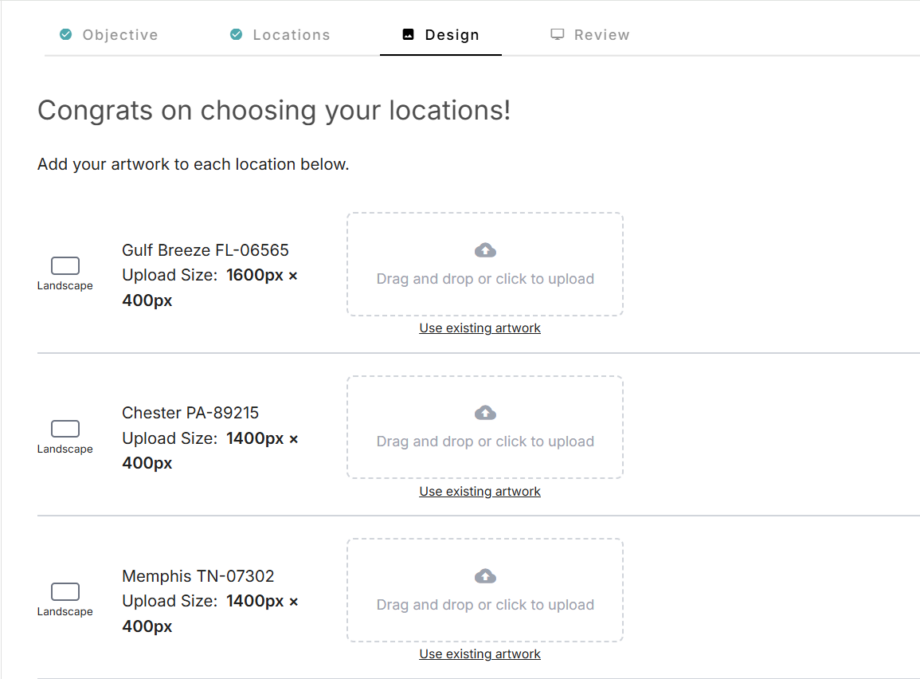
With Blip, you can upload multiple creatives and let them rotate:
- Seasonal variants (e.g., “Winter tire specials” vs. “Summer road trip check”)
- A/B tests of different offers (“$0 enrollment” vs. “First month free”)
- English plus a second language if it fits your audience strategy (Richfield and surrounding communities have notable linguistic diversity; some schools report 40+ home languages, making bilingual or multilingual messaging relevant for certain campaigns).
Dynamic creative rotation is especially powerful when you’re using billboard rental near Hopkins to support different promotions throughout the year without changing your physical media buy.
Using Blip Tools to Target the Hopkins Area Efficiently
Blip’s platform is built around flexibility and budget control, which is especially valuable in a compact market like the Hopkins area.
1. Geo‑target by board
Select only the Richfield boards that best align with your Hopkins‑area traffic patterns:
- Panels on I‑494 and I‑35W for broad commuting reach, including Hopkins residents heading to or from the airport, Mall of America, and major job centers.
- Panels on major arterials for shoppers and errand‑runners who favor local routes to destinations in Richfield, Bloomington, and Edina.
This keeps your spend focused on impressions most likely to include Hopkins residents and visitors to the Hopkins area, so your Hopkins billboards are working where they matter most.
2. Dayparting and schedule control
You can:
- Run heavier in peak commuter periods (e.g., 7–9 a.m. and 4–6 p.m.), when freeway traffic is at its highest.
- Own weekend daytime for retail or event‑driven campaigns, when regional shopping trips and family activities peak.
- Pause or reduce during late‑night hours unless you specifically target nightlife or 24/7 services (e.g., emergency healthcare, towing, or QSR drive‑thrus).
3. Budget and bid strategy
Because Blip sells individual ad plays (“blips”), you can:
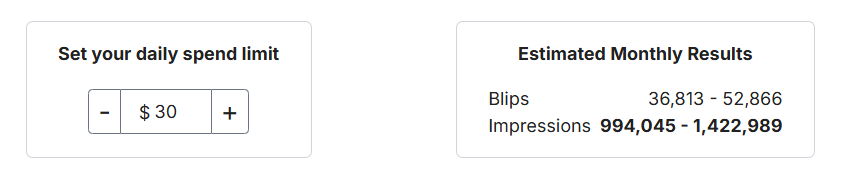
- Start with a modest daily budget to test (for example, $10–$20/day per sign), which might yield dozens to hundreds of daily plays depending on time and competition.
- Increase your max bid per blip during your highest‑value times to win more impressions—especially on weekday peaks where demand for screen time is strongest.
- Use performance data to reallocate budget toward the best‑performing dayparts or boards. If you see that one board along I‑494 drives a higher website visit rate than another, you can quickly shift spend.
This flexible, auction‑style approach makes billboard advertising near Hopkins accessible even for smaller businesses that need tight control over cost.
Sample Campaign Ideas for Hopkins‑Area Advertisers
Here are concrete ways advertisers can leverage the 3 Richfield boards to reach the Hopkins area effectively:
Local retail or restaurant near Hopkins
- Target: Hopkins residents and commuters driving toward Richfield/Bloomington retail hubs.
- Schedule: Weekdays 11 a.m.–2 p.m. and 4–7 p.m.; weekends 10 a.m.–6 p.m. These windows align with lunchtime and dinner peaks, when restaurant visits can spike 20%–50% over off‑peak hours.
- Creative:
“Hopkins‑area lunch? Exit now for [Your Restaurant] – 8 min away.”
“Kids’ meals free on Tuesdays – minutes from Hopkins.”
- Add‑on tactics: Align billboard messaging with features in local media such as the Sun Sailor or event listings on Hopkins Mainstreet
Healthcare clinic serving Hopkins
- Target: Families and working adults.
- Schedule: Heavier on Monday–Thursday 7–9 a.m. and 3–7 p.m., Sunday afternoon reminders for scheduling. Healthcare providers often see appointment call volume spike on Monday mornings and early evenings.
- Creative:
“Same‑day appointments near Hopkins – Book today.”
“Flu shots for the whole family – [Clinic Name] 10 minutes away.”
- Add‑on tactics: Reference seasonal health needs (flu season, sports physicals) and coordinate with community information shared by Hennepin County Public Health
Real estate or apartment community
- Target: Young professionals and families considering moves within the southwest metro.
- Schedule: Weeknight commutes and weekends, when home‑search activity is highest; real estate sites regularly report Saturday and Sunday as key days for listing views and open houses.
- Creative:
“Live minutes from Hopkins Mainstreet – 1–3 BR available.”
“New Hopkins‑area townhomes from the $400s – Tour this weekend.”
- Add‑on tactics: Point to neighborhood amenities such as parks managed by the City of Hopkins and nearby trails.
Events and arts
- Target: Regional visitors plus Hopkins residents.
- Schedule: 2–3 weeks before the event with intensified frequency during the final week; focus on evenings and weekends. For multi‑day festivals like Raspberry Festival, highlight daily headliners and weather‑dependent activities.
- Creative:
“This weekend at Hopkins Center for the Arts – Tickets at [short URL].”
“Raspberry Festival week – Don’t miss tonight’s events!”
- Add‑on tactics: Sync with event calendars and coverage from local outlets like the Star Tribune’s west metro coverage Hopkins Public Schools.
Local media like the Sun Sailor and the Star Tribune’s west metro coverage
Measuring Success and Optimizing Over Time
To get the most from your campaign near Hopkins, we should treat it as an iterative process:
-
Define clear metrics before launch
- Website sessions from the southwest metro (track by city or ZIP; Hopkins ZIP codes like 55343 can be monitored separately).
- Coupon redemptions or promo codes exposed only on billboards.
- Call volume or form fills during specific dayparts.
- Foot traffic trends (for locations with POS or visit analytics), such as counting how many walk‑in visits occur within 1–2 hours of peak billboard windows.
-
Align tracking with Blip data
- Compare performance by day of week and time of day with your Blip schedule.
- If you see strong conversions after 5 p.m., shift more budget to evening commuter periods.
- If weekend visits from Hopkins ZIP codes rise 10%–20% during your campaign, consider sustaining or increasing weekend daypart bids.
-
Adjust creatives based on results
- Test different offers, CTAs, or design styles; even simple A/B tests can reveal lifts of 10%–30% in engagement or redemption.
- Rotate in seasonal or event‑specific messages and retire underperforming ones.
- Use short URLs or QR codes that redirect to campaign‑specific landing pages so you can attribute interest to particular creatives.
-
Integrate with other local marketing
- Sync billboard messages with social, search, and local sponsorships in Hopkins.
- For example, run a billboard campaign alongside sponsorship of a Hopkins youth sports team or arts event, using consistent visuals and slogans.
- Coordinate with local organizations such as the Hopkins Raspberry Festival, City of Hopkins, and nearby tourism groups like Discover St. Louis Park
By combining knowledge of the Hopkins area’s unique demographics and traffic patterns with Blip’s flexible tools, we can build campaigns that reach the right people, at the right times, on the roads they actually travel—turning digital billboards near Hopkins into a powerful, measurable part of your marketing mix and making billboard advertising near Hopkins straightforward to launch, optimize, and scale.